
IRC weapon
Friday July 17th 2009, Author: James Boyd, Location: United Kingdom
Boat of the moment, racing under IRC in the UK this season, seems to be the latest
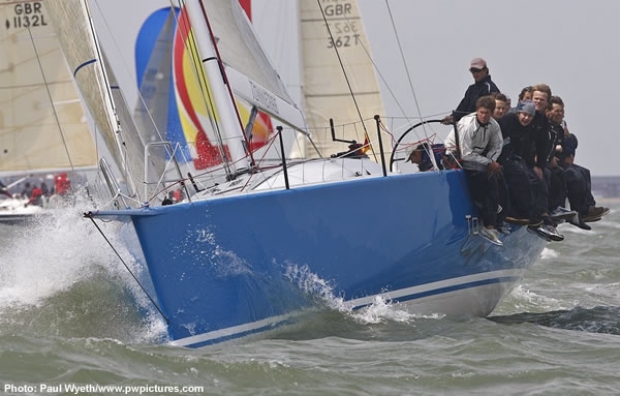
Tonnerre de Breskens of seasoned Dutch owner, Piet Vroon. Since she was completed at Salthouse Boat Builders in New Zealand in March and subsequently shipped to Europe, she won her class in the UK IRC Nationals and then competed in three RORC races winning two of them. With the Channel Race coming up followed by the Rolex Fastnet Race at the beginning of August, she is lining up well to win the RORC’s championship for the 2009 season. And this is with her owner sailing as usual with a predominantly amateur crew, from Holland, Belgium, South Africa, New Zealand and the UK, supplemented with support from his sailmakers at North UK and from the Ker office.
Following on from several Lutra-designed Tonnerres and Formidables, including his 2001 Rolex Fastnet Race winner, Vroon’s latest boat is a Ker-designed 46 footer, his first from the Valencia-based Brit and his team. While length-wise this makes her directly comparable with John Shepherd’s 46 footer Fair Do’s VII, Jason Ker says the new Tonnerre is more of a 2009 incarnation of his 55 footer, Aera, which owner Nick Lykiardopulo took to a Rolex Sydney Hobart race win in 2004. “ Fair Do’s is a cruiser racer, designed with a full interior, whereas this is a comfortable gentleman’s offshore racer,” says Ker. “This is more focussed to offshore than Aera, but on Aera we had watertight bulkheads as well, an enclosed head, a galley, etc.”
According to Ker, the significant design difference compared to Fair Do’s is that the new Tonnerre is designed primarily for racing offshore and thus has a hull shape with good reaching potential. However Vroon’s design brief was also for a boat that could perform well around the cans and so minor adjustments can be made for example to her rig configuration according to the type of racing she is doing.
The new Tonnerre also reflects the gradual modifications made to IRC rule over the years and this is most evident from the shape of her stern. “These days the IRC doesn’t credit overhangs in the same way as it used to when we did boats like Aera. The hull shape is more like modern box rule type hull shapes,” explains Ker.
Unlike Fair Do’s, the idea with Tonnerre was to create a boat that in IRC terms was long for her length and this is most evident from her IRC time correction factor, which is around 50 points higher than John Shepherd’s boat.
“With Fair Do’s we wanted to get it down into the mix of cruiser racers and you can’t do that if you design a boat with a box-rule type hull form. Fair Do’s measures much shorter on the waterline and has a rating credit for that and with this boat we only had the constraint of keeping it in the class Z rather than SZ range.”
She has also benefitted from the added design know-how Ker and his colleagues have picked up working in the America’s Cup, first for Team Shosholoza on the 32nd AC in Valencia and subsequently six months of design work on the AC90 for United Internet Team Germany and then, until the final NY court appeal decision, with the new Russian AC team on the AC33. “Compared to Aera, we are using technology that wasn’t available six years ago, which is a product of the AC,” says Ker. “Traditionally, hydrodynamic design has required a lot of educated guesses, but during the last few years the level of design tools and technology in use by us and a very few other offices has developed to a point where we can be very confident in our path of design progression and evaluate large numbers of shapes and ideas”
There were a few other constraints placed on the design by her owner. Piet Vroon is a 79 year old in his prime, has been racing yachts for four decades and thus has a good handle on what he wants and doesn’t want in his boats. Thus while the interior is stripped out, there are some creature comforts such as a swivel chair at the chart table and a galley with an oven, fridge and all-important coffee making facility. Having adequate headroom over the galley also required that they fit fore-and-aft jib sheet tracks rather than athwartships ones. And the boat also had to have a sufficiently shallow draft to get into Vroon’s berth in Breskens, hence she draws a relatively modest 2.84m. However aside from this, the boat features all the latest gear on the latest Ker hull, the design of which Jason Ker says is related to the evolution of their Ker 11.3 update, the 11.5, the first example of which is due to be completed by US Watercraft in Rhode Island, any day now.
The boat has a bowsprit and in addition to inshore and offshore mains (the former with boltrope, the latter with cars) and the normal array of upwind headsails, they carry four kites and a fractional, plus a jib top, genoa and spinnaker staysails and an A0/A3 hybrid sail, instead of a Code 0.
The rig was made at Hall Spars’ new facility in New Zealand and has two sets of slightly swept-back spreaders. There are Hall Spars locks on the masthead kite halyards which are only used offshore.
The stanchions are Gucci black coloured glass fibre affairs with rollers on the guardrails forward to protect them during headsail drops. Showing her offshore credentials there is a pneumatic seals around the forehatch and just inside of this there is a drop bag. “That works very well, you get no water down there,” says boat captain Matt Trautman (who is also racing the Mini Transat this year on Nick Bubb’s old Magnen boat) of the seal. “You just have to remember to inflate it. It is quite nice for the staysails inshore because you have got the bag there and you can leave the tack permanently attached and you just close the hatch on to it quite easily.”
While the tracks are fore and aft, they have a fine and course tune and the clew can be barber hauled inboard via a single line that works on both tacks and runs down below to a purchase system before emerging back in the cockpit by the pedestal. The vang is a rope purchase rather than a strut. And aside from the mast jack, there are no hydraulics on board.
Back in the cockpit and another offshorey feature is her external sliding main hatch. Either side of this are the pit winches, the port one being counter rotating (as are the main sheet and runner winches on the port side, but not the primary). The winch package is by Harken and the primaries have secondary turning bases for cross-sheeting when required. The primaries are driven by the single central pedestal. This is one of Harken’s new MX models that have the overdrive built into the pedestal itself. The pedestal only powers the primaries and not the pit winch, as is becoming the trend on larger inshore boat. “We could have had a driven pit winch, but it was weight and we were going offshore so quick hoists are not as important,” says Trautman.

Sheet ends are fed through the side of the cockpit into bags below deck, however Trautman says that the screw-on dinghy-style hatches in the cockpit side are of a more watertight variety than those typically found on TP52s in the Med.
The main sheet comprises a strop coming down from the boom and then a simple two part purchase down to the track, each end going forward to the opposite sides of the cockpit. The main sheet track is just short of full width and we understand attached directly into the top of the bulkhead beneath it rather than one or other side of it. A Harken ProTrim hidden below deck operates the traveller, effectively a 36:1 purchase allowing the traveller to be trimmed by hand.
 Behind the two attractive carbon fibre wheels is the single backstay, an IRC feature for northern Europe and there is the option of changing to twin backstays and a flat top main for when the boat heads for the Mediterranean. But the most Gucci feature of all is the carbon fibre pole for the ensign that is not only aerodynamically profiled but can be rotated into the wind!
Below the interior is in functional white and grey, with carbon-look floorboards that are in fact made of glass. Construction of the boat is in carbon with a foam rather than Nomex core and this includes all of the internal structure, while the furniture is constructed from glass with foam.
The layout has the chart table, forward facing, offset to starboard by the mast with the enclosed head compartment on the opposite side of the main bulkhead to this and with the galley to port. Forward of this is a stowage area with a neat wall of crew bags to port and a wet locker to starboard. There is a watertight bulkhead forward of this (there is also another watertight bulkhead just aft of the rudder – again an ‘offshore’ feature). According to Trautman the spinnakers are typically kept forward but all the other sails are stowed aft.
The chart table has Vroon’s big comfy chair and is fitted with a B&G H3000 instrument package, but features also a satphone and GSM phone set-up with an external aerial and is the standard set-up they use for getting on line.
In the ‘saloon’ area there is a fixed seat/bunk to port and starboard with a pipecot above and another set of pipecot aft in the tunnel either side of the cockpit.
The new Tonnerre is simple but functional and if her track record to date is maintained, she will be a boat to keenly watch during the forthcoming Rolex Fastnet Race, where her proud owner is keen to bag his second win.
More photos on the following pages....


Most Read
Most Commented
Comments
Businesses

Pro businesses
-
-
-
United Kingdom
-
Italy
Editor's choice
Member blogs
-
 Ned Collier Wakefield: MOD70 round BarbadosWell that was intense. 12 hard fought for seconds for the win. In idyllic conditions, Tony Lawsons MOD ...
 -
 Mini Transat leg 2 reportThe second leg of the Mini Transat started on 31st October, just over a month after ...
 -
Leg 1 reportI’ve been working towards the Mini Transat now for three years. In 2013 I was part ...
Business blogs
-
 The Island Sailing Club in Cowes, Isle of Wight, is delighted that Prince Michael of Kent ...
 -
Peta Stuart-Hunt chats with the 25 year-old British solo sailor Lizzy Foreman before she sets sail ...
-
The 2015 Student Yachting World Cup (SYWoC), an ISAF-recognised event hosted and run by students for ...
Editor's Choice
All time favourites...
-
 Three legs down into Ian Walker’s
 -
 Winning all but two races at
 -
 For the first time in its
Latest Comments
Add a comment - Members log in