
The new Icarus
Thursday June 25th 2009, Author: James Boyd, Location: United Kingdom
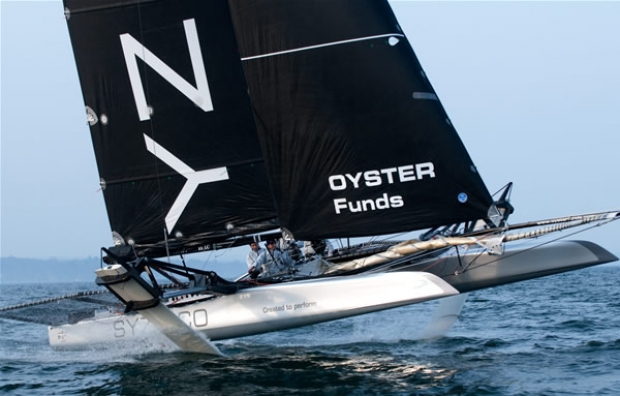
In the beginning there was the foiling Moth. Then came the foiling 18ft skiff. Now a group of owners in Geneva, backed by the Syz & Co bank, are throwing a considerable amount of time and resource into the creation of a successful 9.8m (32ft) long catamaran foiler.
Patrick Firmenich, Jean Pfau, Jean Psarofaghis and Alex Schneiter, the group behind the new Syz & Co foiler cat are well known among the Lake Geneva racing community. They regularly campaign one of the radical Pharos 40 monohulls, as built by Jean Psarofaghis complete with canting keel, water ballast and trapezes (read more about these here) as well as the 28ft M2 catamaran Tilt, in which they have won the Bol d’Or Mirabaud’s M2 class no less than three times. Having achieved in pretty much every class the lake has to offer, they felt it was time to move on…
“I love any sailboat and on the lake with the monohull we did pretty much everything and we won the Bol d’Or three times within five years, so we wanted to move to somewhere else,” explained Alex Schneiter, the team’s skipper and helm, to us at the Bol d’Or Mirabaud start. “You have the one designs like the D35s and M2s, but the Bol d’Or is about new technology, it always has been about that and new innovation. So we thought ‘let’s start something’ and I think the logical step was, we like multihulls, and flying boats is clearly the way to go. I sail a Moth - we have 15 here, although I’m not very good! So we decided to do something different and started with the foiler, which I think is the future anyway.”
The first ideas for the foiler began around three years ago, but the group were not looking for something to merely foil and go fast, they wanted a boat they could actively race on the lake and this meant a boat that could perform on all points of sail, in the lake’s typically light conditions as well as the stronger winds it occasionally throws up, neatly summed up by the French term ‘polyvalent’ for which the English language doesn’t have an exact equivalent. Herein lay the difficulty, Schneiter continues: “You have L’Hydroptere, which is a great machine, but it is 90 degrees full speed and you cannot do anything else. We wanted something that when there is no wind it floats like a normal multihull and goes fast and when there is more wind it goes into a different level. But that is not easy.”
The technical team, Schneiter and his co-owners brought in to solve this particular conundrum, could not have been much more impressive. Design work has been carried out by Van Peteghem-Lauriot Prevost, interestingly on this occasion by Marc van Peteghem and his underlings in Paris (in recent years his Brittany-based partner Vincent Lauriot Prevost has conceived their race boats, but he is currenty tied up with BMW Oracle Racing).
 The structural engineering was by Clemens Dransfeld (left), who has previously worked with Alinghi and United Internet Team Germany.
Hydrodynamics, foils and performance analysis are being handled by Giorgio Provinciali (below) who has previously worked with VPLP on their ORMA 60s such as Gitana XI, Groupama 2, Foncia and Geant as well as the Groupama 3 and Banque Populaire G-Class maxi tris, and the Prada and Luna Rossa AC campaigns. Psarofaghis’ Pharos boatyard in Vesenaz has built the hulls and assembled the boat, while Yvan Ravussin’s company ZR Concept built all the fiddly carbon parts that went into the foil assembly.
 The end result was completed over the winter. Oddly the catamaran, with its pencil fine, razor sharp hulls and reverse bows, has a single, centrally mounted Moth-style single rudder and a T-foil. The main foils meanwhile attach to either end of the main crossbeam, extending out beyond the hulls. The foils are not only retractable but are fitted with Cariboni hydraulic rams enabling them to be angled in from the vertical by up to 45degrees while sailing. In addition the foils are symmetric, but have a trim tab/flap attached to their trailing edge, also operated by hydraulics. Simple, eh?
According to Marc van Peteghem when they started out on this project they did look at all solutions including a monohull with small floats, but as he puts it, this would have required “the crew have come from a circus!” He adds: “In this particular part of the world catamarans are probably better than trimarans because they can be on one hull in very very little wind. That is why we started with what works on the lake and then we had that little kinematic thing that can adapt the foil position from either Archimedian mode or flying mode.”
 Where a multihull wins out over a monohull, even when it comes to a foiler, is down to righting moment, and the stability of the platform and crew weight out on the racks to weather to withstand the power derived from the sails. “A monohull has some advantages for sure,” says van Peteghem. “But I don’t see how you can have enough righting moment to be powerful enough. It works on a very small boat, but nothing is linear in our world! As the boat becomes bigger you need more righting moment to accelerate. I think there is a limit on the monohull - where it is I don’t know exactly, maybe a 35ft monohull. It is difficult to say.”
The foils on the Syz & Co foiler cat are quite cunning as they perform a double function. Upwind in light conditions, when they are positioned vertically, they act the same as a conventional catamaran daggerboard, only that the amount of lift to weather they generate can be ‘dialled in’ via the trim tabs. These represent around 30% of the foil’s cord, tapering slightly at the bottom and can be articulated by up to 12 degrees. However since the amount of lift generated by each board can be different, there is plenty of scope for experimentation. Van Peteghem reckons that upwind they will be using more trim tab on the weather foil.
To get into foiling mode, the foils are articulated inwards by anything up to 45 degrees. With both fully at the diagonal, the foils are obviously generating upwards lifting force, the ride height automatically adjusted as the higher the boat sails the less foil is in the water to generate lift. This is the equivalent arrangement to a foiling Moth’s, where the flap on the trailing edge of the main T-foil, and the amount of lift that generates, is automatically adjusted by a wand hung off the bow that senses how high off the water the boat is. However on the cat in foiling mode the flaps/trim tabs can also be used to provide more or less height if required. This is also dependent upon speed, with less flap/lift required the faster the boat travels. According to Schneiter, the flaps are also turned up when attempting to coax the boat out of the water.
However the flaps also have a less obvious function, as Marc van Peteghem explains: “The problem is that with the foil at 45degrees is that you develop as much side force as you develop upwind force, so you may end up developing too much side force and actually drift upwind. So the windward is used to counteract that and help you to go where you want to go!”
Obvious to anyone who has seen the photos of the Moths going upwind is that they are heeled to weather. This is encourage their T-foil to generate lift to weather. However due to its different foil configuration, the Syz & Co catamaran is still heeled slightly to leeward as it normally would be.
So is the idea to get the weather foil out of the water? Schneiter gives his perspective: “When you go downwind, the best is to have the two foils at 45 degrees. We notice now that you make the one on the weather side a little bit more vertical so it creates more lift and then we tried only one and that works, but it makes it more unstable. You can have the foils at 45deg, 30degs, 20deg, 10deg, etc upwind and downwind and then we have the flaps at four or five degrees but we realised when we were going upwind that 2 or 3 degrees of flap makes a big difference… So you need to be precise on your instruments and it requires a lot of time and tuning, but it is a fascinating machine.”
In their development work VPLP also looked at twin T-foils to use as the main foils but van Peteghem says it was hard to get them to work in a range of conditions. “It is very difficult to make a T foil that is good for 10 knots of speed and 30 knots of speed.” This is something they have tried in the past on their ocean racing trimarans. It is also harder to design a T-foil that can be retracted, although van Peteghem thinks they have come up with a solution to that.
With the Syz & Co cat weight it proving to be the main enemy, for if this is important for the performance of multihulls, it is even more the case for foilers.

This is one of the reasons it only has one rudder. The rudder is fitted with a Moth-style T foil, where the pitch of the foil can be adjusted, to alter the fore and aft trim of the boat (this in turn also has a bearing on the inclination of the main foils). Attempting to ensure that the two rudders are not just aligned perfectly in three dimensions but that the pitch of two rudders could operate in unison, was just too hard. “If you have two rudders, you have to have a connecting bar and it gets difficult to get everything precise and there are more things to go wrong and trim correctly,” says van Peteghem. “It would probably be better to have two but we thought that the gain wasn’t worth the weight.”
The helm is apparently a little heavy before the boat gets on to its foils at which point the balance is much improved.
Weight not only dictates speed, but importantly reduces the amount of wind required to get the boat airborne. According to Schneiter during their first sea trials they were getting on to the foils in 10 knots of wind/15 knots of boat speed. “It is not bad. But still we have to fight all the time with the weight.” The problem is that on Lake Geneva the wind is typically 3-8 knots, hence why right now the Szy & Co foiler cat is out of the water undergoing a rigorous weight loss regime and so missed the Bol d’Or Mirabaud.
 “The concept works - we have been sailing with the boat until three weeks ago,” says Schneiter. “We had some good wind and we were flying nicely and it is stable - it is a good machine, it is fantastic. Without very much tuning we were going very much faster than anything on the lake. But when the wind drops we need to improve our performance. And our take-off speed is a little higher than anticipated.
“We had two months of trails. We did up to 28 knots and actually we did it with very little sail - two reefs in the main and just a jib and without much effort. In the beginning we were going step by step, because we didn’t want to put too much effort on the foils, so we haven’t really pushed the machine whatsoever.”
So back to the weight, and while they parred all they could out during construction, even reducing the crew down from five to four, still much remains to be done. For example at present there are two sets of hydraulics, with their associated manifolds and reservoirs, used to operate the foils and the trim tab/flaps and they want to rationalise this down to one. However although it looks heavy the hydraulic system at present only weighs around 35kg, on an all-up displacement at present of 850kg (already feather-weight compared to the 1300kg D35 cats).

A more significant area of weight loss is to be made in the foils and the structure supporting them. So the engineers can learn all they can about the load case in this area, so the foils are fitted with a fibre optic matrix and in due course this will allow them and the structure supporting them to be replaced with lighter alternatives.
“I guess we have been a bit conservative on the structural side, so by knowing more about the actual loads, we’ll be able to reduce the scantlings in the evolution,” says van Peteghem. “Weight is critical and the campaign to measure the loads is going to tell us how much weigh we can take out of the structure.”
Schneiter says that they are also looking to increase the power. This will mean bigger sails, but also possibly a taller mast, although this will not help with their weight saving regime.
Speed-wise the VPPs for the foiler cat indicate it could go 35 knots. The designers are not keen that the boat is sailed any faster than this because of potential cavitation issues with the foils approaching 40 knots. Foils could of course be made to handle this, but that would compromise their performance at lower speeds – again the point of this boat is not maximum flat out speed, but to be versatile and to perform well in all conditions.
The Syz & Co foiler cat will be back in the water at the end of August and during September the plan is to attempt some records on Lake Geneva.
Schneiter concludes: “We knew from the beginning that it was going to be a long term project, but potentially it is fantastic. It is endless, but it so complex to get it ‘polyvalent’. But it is definitely the future.”
More photos on the following pages...


Most Read
Most Commented
Comments
Businesses


Pro businesses
-
-
-
United Kingdom
-
United Kingdom
Editor's choice
Member blogs
-
 Ned Collier Wakefield: MOD70 round BarbadosWell that was intense. 12 hard fought for seconds for the win. In idyllic conditions, Tony Lawsons MOD ...
 -
 Mini Transat leg 2 reportThe second leg of the Mini Transat started on 31st October, just over a month after ...
 -
Leg 1 reportI’ve been working towards the Mini Transat now for three years. In 2013 I was part ...
Business blogs
-
 The Island Sailing Club in Cowes, Isle of Wight, is delighted that Prince Michael of Kent ...
 -
Peta Stuart-Hunt chats with the 25 year-old British solo sailor Lizzy Foreman before she sets sail ...
-
The 2015 Student Yachting World Cup (SYWoC), an ISAF-recognised event hosted and run by students for ...
Editor's Choice
All time favourites...
-
 Three legs down into Ian Walker’s
 -
 Winning all but two races at
 -
 For the first time in its
Latest Comments
Add a comment - Members log in