
Is it a boat? Is it a plane?
Thursday February 19th 2004, Author: James Boyd, Location: France
These days whenever a 60ft trimaran, Open 60 or even a 100+ft G-Class multihull is launched, despite these being relatively open and supposedly ground breaking classes the result is most often predictable with the exception of some new curve or widget.
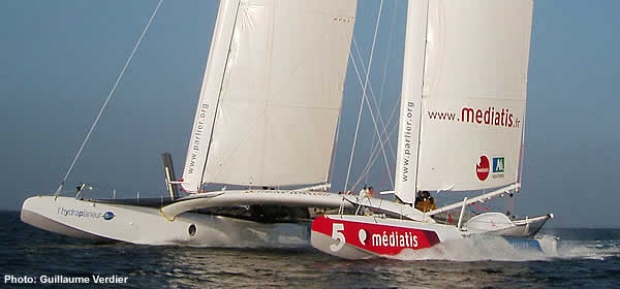
Many bemoan the disappearance of the ground breaking boats of pioneers like Eric Tabarly although conservatism among designers, builders and skippers does serve to make sponsor's money safer. Bucking the trend, as always, is Yves Parlier whose new Médiatis Région Aquitaine is one of the most radical, ground-breaking boats ever conceived.
For starters she's a catamaran. Competitive 60ft multihulls have been around for several decades now and over this period three hulls have time and time again proved faster than two - the central hull allows them better forestay tension going upwind, they have more beam and better righting moment when reaching and less wetted surface area in light conditions.
Yves Parlier's boat has the most massive beam of 15.05m - almost 50ft - giving her the biggest beam to length ratio of any racing catamaran we have come across. But the greatest innovation is in her hulls and rig. The former have the complex shape of a seaplane undercarriage, while the latter ressembles a less extreme version of Pete Goss' Team Philips, with effectively a wingmast in each hull.
To many the boat would seem like sheer lunacy, were it not for the fact that the brains behind the Médiatis Région Aquitaine project is Yves Parlier.
There is the famous story from the last Vendee Globe when Parlier was leading the race until his mast snapped. Instead of retiring he pulled into Bluff, New Zealand, fixed the carbon spar with materials he had on board and singlehandedly restepped the mast without outside assistance. He then sailed half way around the world running so low on food that he was forced to eat seaweed.
While his last Vendee Globe was a tale of heroics, Parlier has repeatedly demonstrated himself to be one of the French's most competitive offshore sailors. He is one of the few people to have won both the Mini Transat and the Solitaire du Figaro and he holds a host of wins in his two Open 60s Cacolac d'Aquitaine and subsequently Aquitaine Innovations.
But what puts Parlier (above) a cut above the rest is that like Eric Tabarly and Michel Desjoyeaux he is a keen innovator. With Aquitaine Innovations for example he was the first person to transplant the more powerful rotating wingmast rig of a 60ft multihull on to an Open 60, imaginatively widening the shroud base with the use of deck spreaders that remain a feature of many competitive Open 60s to this day.
It was during his first Vendee Globe in 1996 aboard Aquitaine Innovations that Parlier began thinking about what he would do next. "I was interested in multihulls and by looking for a new solution for multihulls," he recounts. Sadly it would not come to pass as quickly as he had imagined. Failing to win the 1996 Vendee Globe he set his sights on the next race in 2000, planning that his new ground breaking 60ft multihull would be ready for him to step on board by the time he returned. Fat chance.
When she was first put in the water on 1 February 2004 Médiatis Région Aquitaine had been some eight years in conception.
During this time Parlier and his team carried out an impressive amount of homework. "I perfected my knowledge of multihulls," he says of how he spent this time. He had sailed on a lot of Hobie cats. During the late 1980s he had campaigned a Formula 40 catamaran and raced on some of the bigger multihulls. This included the Round Europe Race on board Laurent Bourgnon's Primagaz and during the last leg of this race from Finland to Stockholm the Franco-Swiss trimaran had suffered structural damage at one of the float to beam joints. While this was taking place in the distance Philippe Poupon's trimaran Fleury Michon XI had completely folded up when her main hull snapped in two - two significant events that went into the Parlier mental notebook.
Parlier says he got the views from all the multihull skippers he could including the late Eric Tabarly.
One particular avenue of interest was foil-borne trimarans such as the Hobie Tri-Foiler and the 17ft long WindRider Rave. On a bigger scale he also sailed on Alain Thibault's L'Hydroptere. During a passage between Morgat and Douarnanez when he was on board the 75ft tri-foiler hit 39 knots. "We had good speed in not exceptional conditions. We did 39 knots - it was good, but I think it can go faster," he recalls. At present L'Hydroptere is once again being repaired and is expected to be relaunched this summer.
While this was a promising line of research Parlier says he became distracted by an interesting catamaran that by coincidence was being developed in his hometown of Arcachon in the Aquitaine region of south west France.
Jean-Francois Morice worked for aerospace company Dassault, makers of the Mirage aircraft. Aquitaine is known for being the centre of France's aerospace industry and in the past seaplanes were built nearby to Arcachon in the town of Viscaros. Morice had carried out considerable research into the prospect of using a seaplane-type stepped hull on a 25ft catamaran he eventually had built by Thierry Eluere.
Stepped hulls were first used on powerboats in the UK at the end of the 19th century. The first stepped hull seaplanes date back to the mid-1900s. "Without the step a seaplane can't get up to the speed," explains Loic Goepfert, who is part of Parlier's design team and previously sailed with Le Defi's last two America's Cup challenges. "When the engines for the planes are really strong, it doesn't matter so much, but in the beginning of the sea planes, they had really small engines and so they had to take a lot of care to minimise drag and maximise lift."

An early French seaplane - built in 1913 - with a large step in the hull just forward of the wheels
By their nature seaplanes must be able to reach a high speed so they can take off. To achieve this they have a peculiar shape to their 'main hull' that effectively is in two parts. On modern designs the bow is angled slightly upwards and has a deep-V shape forward. This V-shape shallows out to form a planing surface roughly one third of the way back from the bow. There is then a step in the hull - a hydrodynamic device where the turbence aft of the step has the effect of reducing wetted surface area. Stepped hulls are frequently used on racing powerboat hulls, which often have as many as two or three steps. The aft section of hull again has a shallow V-shape for planing. The result is that at speed the hull plans on the aft part of the forward and back sections of the hull.

Above: showing the V-shaped hull form forward

Above: a more modern seaplane showing the step in the 'hull'
Initially Parlier says he was sceptical about the seaplane hull shape. "I thought it was a big problem in the waves," he says. "I imagined a motor boat slamming and for me with my experience with Primagaz, waves are a big problem for multihulls. Then I thought foils were better to cut the waves - to make a flying hull."
However he persevered with Morice and spent the best part of a year trialling the 25ft cat against a tri-foiler designed in the States by Dr Sam Bradfield, designer of the WindRider. Following these tests Parlier concluded that he prefered the seaplane hull because it would perform in a wider variety of conditions.
"We were still a bit afraid about the waves, but when we made a test in the Bassin Carrin [test tank] in the waves, it was very good," says Parlier.
The decision to go with the seaplane-type hull shape was made four years ago. By this time Parlier had formed the Aquitaine Design Team comprising a core group of Romaric Neyhousser, Guillaume Verdier and Loic Goepfert - all graduates from Southampton University. In fact the number of people involved with the design and different aspects of its research would ultimately number more than 20. Morice was still involved initially but his ideas - such as being adamant the new boat have a solid wing sail - were too extreme even for Parlier. Morice has a patent for using this hull technology on sailing boats which has since been acquired by Parlier.
Their test program continued on unabated. They took a Hobie Tiger and put a step into the hull (see photos on the following pages). By all accounts this was not successful. They also tank tested three different seaplane-type hulls. The best of these they made a radio controlled model. One version of this had fitted on each hul a Aerorig (with a 'balestron' boom extending forward of the mast for the tack of the jib - a system that had been tried in France in the 1980s on Marc Pajot's giant catamaran Elf Aquitaine).
The team set about developing and refining the design. They gained a lot of valuable insight into their hull shape by reading the research information carried out on seaplane design during the 1910s to 1950s.

Loic Goepfert says that on a smaller boat they could have had a single step and no aft section to the hull. On skiffs for example sailing fast is achieved by the crew being right back on the racks so the boat is planing on its transom, the bow out of the water. Because they are unable to move weight around to the same degree on board the big cat they have had to position the step in the hull below the centre of gravity of the boat and have two planing surfaces on each hull.
One of the more crucial decisions was establishing the right beam for the boat. This was important to ensure that, considering the weight of the boat, it had enough righting moment to be competitive against 60ft trimarans and that there was adequate separation between the rigs.
With the catamaran format decided using two masts, one mounted on each hull, seemed an obvious choice as it removed the massive compression loads from the centre of the main crossbeam lowered the centre of effort of the sail plan.
In a wind tunnel they tested three different rig separations - 9, 11 and 13m. "We discovered that 9m was a disaster, 13m was good and 11 was nearly as good as 13," says Loic Goepfert . "It is not linear - you are overlapping or not - so finally we were happy with 11m, and decided to go with that."
In the end the design team also decided to toe in the tops of the two masts because the top of a mainsail has less roach than the bottom. While the masts have 11m separation at their step they have 9m at the top. This also has the effect of lowering the centre of effort of the sail plan.
Unlike Team Philips the masts are in fact not mounted on the hulls but on the arch of the crossbeams close to the hulls. The rigs are also stayed, not freestanding as Team Philips' were. In fact the masts are not mounted on the crossbeams to allow the possibility of outboard stays, but to enable a main sheet track to be used. On Team Philips they avoided main sheet tracks by having a substantial windsurfer-style wishbone to handle the outhaul loads. On Médiatis Région Aquitaine they have a main sheet track at the back of each cockpit and even with the masts inboard the tracks still extend outboard of the hull, mounted on a spar.
The rigs are joined close to their top by a cross bar and then are stayed diagonally between the rigs, an arrangement similar to Tim Coleman's famous speed sailer Crossbow. Thus on starboard tack it is the diagonal on the port rig holding up the spar while the starboard rig is kept from falling off to leeward by the cross bar. Outboard stays for the rigs, even ones attached to Open 60-style deck spreaders, were discounted because they presented too much drag - a significant issue on a boat expected to reach more than 40 knots.
There is a running backstay on each rig attached centrally on the aft beam but these are there to stablise the rig when using the genniker.
Unlike Team Philips the rigs are structured so that the boat can be sailed like a proa - with only one of the mainsails up. They can also fly headsails - at present only a small jib and a genniker, but do so from the leeward rig - on Team Philips they flew headsails from the weather rig, where there was a convenient sheeting point for them).
Parlier believes they will only use the ORC upwind in up to 14 knots of breeze and the genniker up to around 8 knots.
This article continues with part two tomorrow
More photos on the following pages

Most Read
Most Commented
Comments
Businesses

Pro businesses
-
United Kingdom
-
United Kingdom
-
France
-
Editor's choice
Member blogs
-
 Ned Collier Wakefield: MOD70 round BarbadosWell that was intense. 12 hard fought for seconds for the win. In idyllic conditions, Tony Lawsons MOD ...
 -
 Mini Transat leg 2 reportThe second leg of the Mini Transat started on 31st October, just over a month after ...
 -
Leg 1 reportI’ve been working towards the Mini Transat now for three years. In 2013 I was part ...
Business blogs
-
 The Island Sailing Club in Cowes, Isle of Wight, is delighted that Prince Michael of Kent ...
 -
Peta Stuart-Hunt chats with the 25 year-old British solo sailor Lizzy Foreman before she sets sail ...
-
The 2015 Student Yachting World Cup (SYWoC), an ISAF-recognised event hosted and run by students for ...
Editor's Choice
All time favourites...
-
 Three legs down into Ian Walker’s
 -
 Winning all but two races at
 -
 For the first time in its
Latest Comments
Add a comment - Members log in