
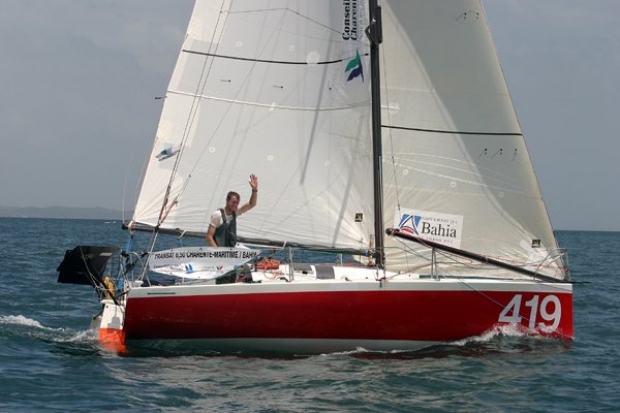
Totally exceeding my expectations
Wednesday November 14th 2007, Author: James Boyd, Location: United Kingdom
My long held hope of placing top ten in the Mini Transat had been badly dented by a poor placing on the first leg. I had ended up in slightly the wrong place on the first night close to the middle of a ridge of high pressure, and spent the rest of the leg playing catchup, finally finishing in 22nd. Of course breaking the end off my spinnaker pole on the last day hadn't helped my cause, but probably only cost me an hour or so. Fortunately, despite my poor finishing position, the time difference to all bar the two leaders was not that great, giving me some hope if I could muster a good second leg performance.
East or West?
After two weeks in Madeira, we were all more than happy to be on our way. However, a depression centred around the Azores was playing havoc with the North Atlantic high and a period of very light winds was forecast for after the start. From the models, it looked the the option was to go either east or west, and that you didn't want to get stuck in the middle. But each new update to the weather models was substantially different and you knew there was going to be an element of luck to getting a good start.
The start
Starts with 89 singlehanded boats are always interesting affairs, especially with many of the sailors not coming from strong dinghy background. On our first start, a general recall was issued but the second time, we managed to get away cleanly. My timing and positioning was ok, but I got caught in the dirt of one of the race favourites, Sam Manuard on Sitting Bull and so was a little slow off the line. The committee had set a 'degagement' buoy just off the shore to aid spectating, so after sailing on for a bit on starboard, I tacked across on to port, picked up a small lift I was expecting and ended up perfectly on the layline and rounded the mark just outside the top ten. I always find the starts stressful and it's always a great relief to get away cleanly without incident and to be able to get on with the sailing. My friend, the Slovenian Andraz Mihelin wasn't so lucky - I'd heard on the VHF that another boat had t-boned him (a port tacker) and he was returning to port to make repairs. Having colided with a media boat after the start of the first leg, this was destined not to be Andraz's race.
Not again...
After a solid southwesterly breeze for the start, the breeze had started to lighten. Everyone is supposed to call in with their positions for the twice daily sched at 0800 and 1900 UTC so by the first evening you had an idea about where you were positioned in the fleet. I had chosen to take a bit of easting but it turned out that I was positioned fairly much in the middle of the fleet east to west. The wind was light and variable through the night and I heard in the daily meteo and classments (rankings) over SSB (short wave radio) that I was in 20th position. I was pretty worried at this point that I was going to lose track of the leaders as had happened in the first leg - and it seemed that the boats further to the east were doing better. I set about cutting my losses, getting on the wrong gybe and getting some east in - at least I was in good company at this point, sailing with Sam Manuard, one of the race favourites who had placed second in the first leg. Slowly the trade winds start to build and I gybed back on to port and started to think ahead about my passage through the Canaries. The next day I listened in on the classments - I had moved up to ninth place - woah! Whatever I had done the previous evening had been the right thing.
The Canaries
My positioning a little to the east set me up to pass through the Canaries through the west most passage between La Palma and Gomera/Tenerife. In our pre-race weather training we had discussed the wind acceleration between the islands here so I was expecting the 15 knots of gradient wind to turn into 25 knots passing through here. With that sort of breeze and not expecting the sea state to be too bad, I reckoned I could hold on to my medium spinnaker. How wrong I was! The breeze was 20 knots, then 25 knots by which time things were getting fairly entertaining on the helm. Then we had a gust in the low 30s and I couldn't save the boat from a huge broach. I was violently ejected from the high side of the boat falling to leeward, banging my head on the boom on the way, cutting my arm on the guardwires and absorbing the majority of the impact with my ribs. I was now swimming totally immersed in the water but still within the guardwires. I spluttered a few breaths and hauled myself back into the cockpit. My pulse was racing but knowing that a botched takedown would likely damage one of my precious kites, I composed myself while trying to ignore the flogging kite. I carefully flaked out the tackline and halyard, blew both and then pulled in like crazy on the sheet. Phew! Everything came in nicely.
By this stage though, I could see a couple of other boats around flying past me with Code 5s (storm spinnaker) up, so I quickly grabbed mine and hoisted it thinking that would be a good conservative option. Shortly after the wind increased to a steady 30 knots - I was stuck on the helm, totally underdressed in salopettes and t-shirt. We were averaging about 15 knots and I was getting constantly drenched as we nose dived through the back of some steep, short waves. For a short while the wind was gusting over 35 knots, and we were skidding over the surface of the waves almost totally out of control - I later checked the GPS and noted that we had peaked doing 19.5 knots! By this stage I was praying that the wind would start to drop – the concentration and aggressive helming required to keep the boat in a straight line were slowly tiring me out and I was starting to get pretty cold.
I was relieved when the wind slowly started to drop and took the opportunity to put on the autopilot dry off and change out of my foulies into my dry suit. The relief at the dropping wind suddenly turned to concern as the breeze fell to under 10 knots. I checked the GPS and saw that we were 105 miles from Tenerife - I knew that the wind shadow was big, maybe 50 miles of so, but could it be that big. I quickly gybed on to the unfavoured gybe and sure enough, after a few miles of sailing we were back in 25 knots of wind again. Three gybes later and I was happy to be well clear of the Canaries.
As I listened to the sched and meteo the next morning we had jumped to ninth. Perhaps the previous days pain had made some miles for us. As the breeze now had eased in the low 20s, it was time to switch up to a bigger kite. I decided on going for my small fractional kite which is actually my medium kite with a reef – however I realised when I went to put in the reef that the zipper had been partially ripped off, damage that must have occurred in the previous day's dramas. I set about making a repair, sticking and stitching it back on. I put it and up and we were moving along swiftly again. I checked the repair a couple of times in the next few hours but at one moment, the pilot came up on the wind a bit and all of a sudden the kite was in pieces, ripping up one tape, across the foot and up the middle. Ouch! There was no way I was going to be able to make a repair at sea and we still had another 1000 miles of sailing downhill to the doldrums. I had lost half of my spinnakers and would now be stuck switching between my Code 5 (40sqm) and my big spinnaker (85sqm) - it was not going to be pleasant sailing – either underpowered or totally out of control at the crossover wind speed.
Feeling quite down about the situation and my own stupidity for not having taken more care, I slept quite a lot of the night, only waking as usual every half hour or so to check the boat and look for ships. At the next morning's sched I expected to have started to slide back down the ranking but was stunned to hear that we had moved into fifth. Wow! I wasn't expecting that. Maybe things weren't quite so bad after all... And by the following day, my good position on the east side of the course had pushed me into third - it was a real thrill to be this far up the fleet.
The Cape Verdes
The next navigational challenge was how best to negotiate the Cape Verde islands. These are a compulsory gate in the course so there is no avoiding them. The passage through the northern islands was quite simple but for the southern islands, things are a bit more complicated. I had chosen to leave Fogo (altitude 3000m) to port and pass between it and Santiago (also substantial at 1400m). Obviously avoiding the wind shadow of any of these islands is a significant concern. Suddenly Fogo was visible out of haze and despite being 25 miles away, it was huge, massively impressive, with steep, black, rocky slopes. As I approached, the wind which had been from the NE, start to swing more easterly, which was worrying bringing into play a wind shadow effect from Santiago. It was too late alter course to round Fogo to port instead so I continued, being sure to position myself to the far west of the passage, as far away from Santiago as possible. It wasn't far enough however, and as I sailed alongside the south-east corner of Fogo the breeze started to drop until it was about 6-8 knots.
Doldrums
The doldrums are truly a nightmare for any solo sailor – squalls, light winds followed by more squalls. For me it was three days of the hardest sailing I have ever done. It felt like a marathon of non-stop sail changes as the wind climbed up and down and the direction left and right, all interspersed by torrential downpours. The end of the doldrums was marked by a spectacular, almost supernatural line of dark grey cloud – it was such a great relief to be out into blue skies and fluffy white cumulus clouds. Finally, we were into the final run home.
SE Trades
That relief was tempered by concern about the charge of my batteries. Since my only charging mechanism on the boat was solar panels, 4-5 days of continuous cloud had left my them almost empty. Most of the power on the boat is consumed by the autopilot, so in order to reduce my power consumption and allow the batteries to recover some charge I stopped using the pilot and tied off the helm with a piece of rope. Fortunately, the weatherhelm I have on Rafiki allows the boats to be balanced really nicely if sailing on or just off the wind. While the wind speed is steady this is great, but if the wind drops then usually you wake just as the boat has borne away into a crash gybe. This happened a few times and was made all the more painful by the fact that the boat was fully stacked and the keel fully canted. Fortunately I was always able to gybe the boat back around without centering the keel so we didn't waste to much time.
As we proceeded south the wind slowly backed from south to the south east enough to switch from using the solent to the gennaker. After about half a day of sailing with the gennaker I came up on deck after a nap and saw, to my dismay, that the luff of the sail had ripped out and the whole of the second top panel was flapping about. The sail had failed through a design and build fault - the overlap between materials was simply not enough to hold the sail together (I later found out that quite a number of other competitors had the same problem). With days of reaching ahead this was not a sail that I could afford to lose. So, convinced I could effect a good repair I gathered all my sail repair materials together and set about sticking the panel back in place. Fours hours later, after painfully sticking the sail back together, all the time trying to avoid the splashes of water on deck, it was ready to go. I rehoisted it and unfurled it and for it about 15 minutes it was fine...then pop. Having used most of my sticky dacron up on the first repair, I no longer had enough to have a second attempt – I returned the the dead sail to it's body bag and resigned myself to a strategy of sailing high with the solent and the switching to my Code 5 once the breeze had backed enough.
By this stage of the race, quite a number of tracking beacons had stopped working, so I had no idea how I was doing or the boats around me - it also meant that tactical moves to cover others were no longer possible. So, the next few days were just spent trying to sail best speed to Salvador.
Despite the competition for places, by this stage of the race I was finding increasingly difficult to stay motivated. It was becoming hard not to “just want to finish”. The monotony of sailing at the same point of sail wasn't helping. Then came the last day, which is always mentally the toughest. No matter how hard you try, it's impossible not to have one eye on the distance-to-finish. Constantly dividing distance by speed, calculating the time to the end. By this stage I was able to fly my Code 5 and in 15-20 knots of breeze, the miles were ticking by, and I tried to sit back and enjoy my last hours aboard.
Finish
In the end, I was pipped for the podium arriving about half an hour after Fabien Depres aboard Soitec (617). But my fourth place for the leg and fifth place overall for the race so totally exceeded my expectations that it wasn't possible to be disappointed. In fact, the joy and relief at just arriving in Salvador completely overrode any consideration about my finish position. In the best Mini tradition, I ended up in the water many times that afternoon as the next couple of boats arrived in.


What next?
Minis are the most wonderful, exciting boats to sail - they are also the wettest and most uncomfortable. The sailors who sail them are, as a group, a fantastic bunch of people - so friendly and open and welcoming. However, for me it's definitely time to move on. Part of the enjoyment of placing well in the Transat is the relief that I feel no compulsion to come back next time and try again. My boat Rafiki is now up for sale and I am now back in London working in my regular day job as a computer programmer. As strange as it seems, it is quite nice to be back to the mundaneness of ordinary living, to reflect and to relax.
My short term aim now is to get back and enjoy some fully crewed sailing preferably as nav/tactician racing inshore and offshore. I also plan to keep a hand in the minis by doing some two-handed races next year. Once you've been bitten by the 'mini' bug, it's too hard to give it up completely.
Most Read
Most Commented
Comments
Businesses
Pro businesses
-
United Kingdom
-
Italy
-
-
France
Editor's choice
Member blogs
-
 Ned Collier Wakefield: MOD70 round BarbadosWell that was intense. 12 hard fought for seconds for the win. In idyllic conditions, Tony Lawsons MOD ...
 -
 Mini Transat leg 2 reportThe second leg of the Mini Transat started on 31st October, just over a month after ...
 -
Leg 1 reportI’ve been working towards the Mini Transat now for three years. In 2013 I was part ...
Business blogs
-
 The Island Sailing Club in Cowes, Isle of Wight, is delighted that Prince Michael of Kent ...
 -
Peta Stuart-Hunt chats with the 25 year-old British solo sailor Lizzy Foreman before she sets sail ...
-
The 2015 Student Yachting World Cup (SYWoC), an ISAF-recognised event hosted and run by students for ...
Editor's Choice
All time favourites...
-
 Three legs down into Ian Walker’s
 -
 Winning all but two races at
 -
 For the first time in its
Latest Comments
Add a comment - Members log in