
Singlehanded round the world one design
Thursday December 6th 2007, Author: James Boyd, Location: United Kingdom
Several new shorthanded round the world races have been announced over recent months, but while there seems to be an increasing appetite for this form of racing, is demand great enough for them all to survive? One of the most promising is the SolOceans, a one stop race in one design 52 footers, organised by SailingOne, the company of highly capable Frenchman and one time
L'Esprit d'Equipe crewman Yvan Griboval. The race is scheduled to start and finish in France with a stopover in Wellington, New Zealand and will be held for the first time in 2009, starting on 29 October.
Griboval has managed to tick all the boxes. Initially he got Michel Desjoyeaux to be technical advisor for the new boat and to create the one design he commissioned Finot-Conq, who have penned the last four Vendee Globe winners. Female tooling was created by well known La Trinite-sur-Mer boat builder Charlie Capelle, while production boats are to be built by JMV Industries in Cherbourg who have built many of the most successful Open 60s of the last decade and a half including Christophe Auguin's Groupe Sceta and Geodis (his BOC Challenge and Vendee Globe winners) and Mike Golding's first Open 60 Team Group 4.
Most significantly Griboval has secured sponsorship from the backers of Roland Jourdain's Open 60 Veolia, who have been given naming rights to the one design, now known as the Veolia Oceans. This is somewhat confusing -shouldn't Veolia Oceans be the name of the race? The race's Kiwi stopover was endorsed by New Zealand Prime Minister Helen Clark in Paris earlier this year.
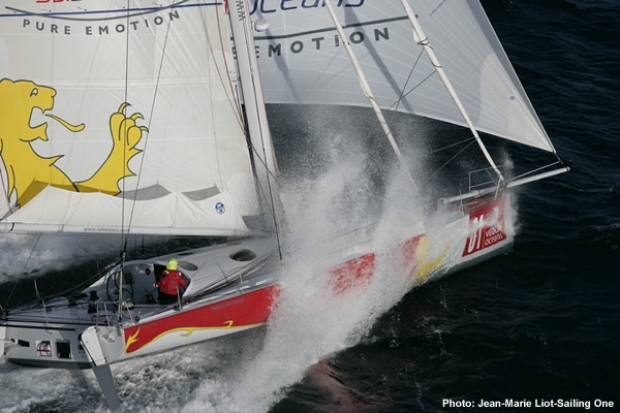
Recently the SolOceans entered a new phase with the launch of the first Veolia Oceans one design, which ventured across the Channel recently for a brief visit to Southampton, where thedailysail were fortunate enough to be shown around by one of Griboval's technical team, Yoann Richomme. On board during our visit were four crew all involved in the Figaro class: Eric Tabarly's nephew Erwan, a successful skipper, boat captain Erwan Lebec, who with Richomme has run the shoreside for several leading campaigns such as those of Charles Caudrelier and Yann Elies. Also on board was Amer Sports Too bowgirl turned Figaro sailor Liz Wardley.
In terms of general concept, the Veolia Oceans is a smaller, dumbed down Open 60, although still bristling with state of the art features. Her hull shape is beamy with a substantial chine running down the length of her topsides, exactly as it does on Finot-Conq's latest Open 60s BritAir, Generali and Hugo Boss. The hull, deck and spars are all carbon fibre. The boat has a canting keel, twin asymmetric daggerboards and a rotating wingmast rig. While the Veolia Oceans is a scaled down Open 60, the principle differences are the retractible bowsprit which when launched extends more than 2.5m beyond the bow (Open 60 bowsprits now tend to be fixed and their length is limited by IMOCA class rules to 1.8m max) and the one design, built down to a price aspects of the boat.
The rig is slightly unusual compared to modern Open 60s. While it is a rotating wingmast, rather than having deck spreaders or conventional-looking spreaders hinged at the mast as fitted on all the latest generation 60s with rotating spars, the Veolia Oceans' wingmast rotates, but is entirely spreader-free.
"There is more shroud tension and a heavier tube, but it is a simpler set-up," says Yoann Richomme. This rig configuration is one Finot-Conq have been touting for a decade or so now. A canting version of it was originally fitted to the Sodebo Open 60 prior to the 2000 Vendee Globe (but with twin sets of runners) and won the Open 60 class in the Transat Jacques Vabre in 1999 before this rig configuration was swiftly outlawed. However Finot-Conq have used a non-canting version of this rig on many of their smaller one designs such as the Open 7.50 sportsboat and the Gyro 34 used for the round Italy race. Most recently they have put the rig on to a 52ft 'cruising' boat and now the Veolia Oceans boat.
While a heavier tube means more weight aloft, the rig has distinct advantages in terms of low windage and, for a lengthy round the world race, a lack of chafe. It is no coincidence that all of the ORMA 60ft trimarans have ended up with rigs of this type - although they obviously benefit from a much wider shroud base.
"We are quite impressed - it is a lot better than we expected," says Richomme of the mast. "It will rotate by up to +/- 40 degrees. It is limited by how much the pins in the shrouds will turn. It is quite enough."

While JMV built the hull and deck, the mast, boom and bowsprit were built by Alucarbon in Switzerland who we last heard of as the company which constructed the spars for the 2000 generation of Finot-Conq designs built at JMV, such as Team Group 4.
While Open 60s may carry around 15 sails on the Vendee Globe, an example of the one design budget-consciousness of the Veolia Oceans boat is its very limited sail wardrobe. The sails, to be made by North France for all the boats, comprises a spinnaker and genniker, both fractional and flown from the retractible bowsprit. The bowsprit is mounted on deck and extends on a 2:1 purchase that also serves to tension a bobstay.
While on modern Open 60s all the forestays can be removed, with the exception of the Solent which is permanent, on the Veolia Oceans, there are two permanent forestays for the Solent and staysail, both sails kept permanently hoisted, furled using Karver gear. In addition to this are the mainsail and storm jib, the latter hoisted on a furler, bringing the sail tally up to a mere six. "The class rules haven’t been written yet, so I don’t know how many sails you can buy," says Richomme.
Standing rigging is Navtec PBO while the forestays and runners are Navtec Kevlar.
Unlike modern Open 60s, where most halyards are 1:1, thanks to their bigger winch packages and pedestals, the Veolia Oceans relies on older technology, all halyards being 3:1. "It's so that you can hand them up," explains Richomme. "It is a lot of the rope on the deck, but it gets up there. The reason was that you can feel if there is something wrong, whereas if on a winch, you don’t." There is also an external 'man halyard' allowing skippers to scale the mast. The main halyard leads back to the cockpit while the headsail halyards are operated from in front of the mast.
The boat has runners but the shrouds are set-up in such a way that it is not necessary to have the runners on when gybing - another feature designed to aid singlehanders. "You need them if you nosedive in big conditions to keep the mast in column," says Richhomme. "We’ve nosedived down to the mast and it is still here! We’ve sailed in pretty tough conditions, and we haven’t broken anything yet. We’ve really launched her down waves but it is a different school of thought to an Open 60. We don’t do anything light. It should be pretty safe."
According to Richomme, all the gear fitted to the boat is from major suppliers so that it can be repaired or replaced anywhere around the world. Thus furling gear and blocks are by Karver, jammers and organisers by Spinlock, the rest of the deck package including the winches are from Harken.
Another simplification of the Veolia Oceans, compared to Open 60s is in the internal water ballast. While modern Open 60s are described as 'fish tanks' because they carry so much water ballast internally, usually split between three tanks on either side of the boat, the Veolia Oceans only has one tank inside the stern on each side, each tank with the capacity to load on 1.2 tonnes of water. As a result the boat is less flexible in terms of how it can be trimmed fore and aft, but the set up of the boat has been adapted so that it has naturally a slightly more bow-down trim, which can be righted by the aft ballast.
"They have changed a bit the set-up of the rig, keel and the bulb, so that it doesn’t pound upwind, which is quite surprising," says Richomme. "It goes 11 knots upwind in breeze and it doesn’t slam as much as an Open 60. We are quite happy about that. And as we have a long bowsprit the sails really lift the boat up downwind."
There are no tracks for the headsails, instead they have the 'ABN AMRO' set-up with sheets fed through a ring with an outhaul and a barber hauler to alter clew position. The crew are still experimenting with this.
Another budget aspect of the boat are the fairly agricultural way lines are fed back to the cockpit from the mast. While on 60s they are usually pass through the cabintop, on the Veolia Oceans boat they simply run around it. This makes for simple maintenance but results in very cluttered sidedecks. Given that the boat is to be sailed singlehanded rather than by a full crew, perhaps this is not an issue.
Compared to the current thinking in 60s, the cockpit layout is quite old school. Modern 60 cockpits are open at the transom, but the Veolia Oceans has an aft deck and while safer, this offers the potential for the cockpit filling up with water and for the huge amount of rope in the cockpit clogging up the drains. However it is probably easier to build and better structurally and provides a mounting point for the full width mainsheet track running along the aft extremity of the deck. A satcom dome (although not the giant Fleet 77s used on the 60s) is also to be mounted in the aft deck.
The boat is fitted with twin wheels at the front end of the cockpit. Forward of this is a seat either side beneath the cabintop overhang. Bonhomme says they might add some more protection for the helmsman. For safety reasons, the twin rudders are transom-hung and are fitted with a carbon 'fuse' enabling them to pop up in the event of a collision. However unlike modern Open 60s they are not designed so that the weather rudder can be routinely pulled up to reduce drag.
The wheels individually drive each rudder via a Vectran rope system with a crossbar linking the rudders at the transom. A ram for the all-important autopilot is mounted down below on each side.
As is the case with 60s, the rudders are well balanced in order to minimise the power drain from the pilots. "In 5-10 knots it is quite hard to steer and then when the wind picks up they are quite well balanced," says Richomme.
Construction is in carbon fibre with a Nomex core cooked to 90°C, however as is typical of all the 60s Finot-Conq have speced in the last decade, the hull laminate is monolithic (ie no core) from the back of the engine all of the way forward to the bow, strengthened by longitudinals, to prevent delamination due to slamming. While the rest of the hull and deck is Nomex cored, some of the bulkheads are Airex. "It is not as light as construction as an Open 60, but it is not far off," says Richomme.
The all-up weight of the boat with sails on is 7 tonnes, which is about a ton less than the lightest of the new 60s. This is because there is more structure inside, the rig is heavier and generally everything about the boat is a little more beefy. When we say there is more structure inside, this is no understatement. In from the bow there is a crash bulkhead to maintain the integrity of the hull in the event of a head on collision. Then there are six bulkheads aft of this, one more than 60s are obliged to have. All of these bulkheads are watertight.
The boat has a canting keel, with a carbon fibre fin. Finot-Conq have considerable experience in designing these appendages now and the fin is over-specced to avoid potential problems experienced in the 60s, of flutter, falling off, etc. The keel is canted by twin rams, each capable of fully moving operating the keel independently (as on the Volvo 70s). A potential false economy is that the rams are what Bonhomme describes as being 'industry standard'. The idea is that they can be easily replaced anywhere in the world, however while their shaft is stainless steel, the housing isn't and may suffer corrosion, eventually degrading its sturctural strength. There is the potential to operate the keel manually, and the team are currently working on a way of locking the keel in the centre.
The daggerboards are mounted directly athwartships from the canting keel and are asymmetric in profile and toed out at 16° to the vertical. They are similar to the Finot-Conq Open 60s in that when lowered the top of each board drops to halfway down the case rather than to deck level. While this creates more load in the case it makes the boards lighter while still allowing substantial draft. Certainly Generali seems to be having no trouble sailing upwind in the Transat Ecover BtoB at present . For safety reasons the daggerboards are reversible and in theory at least, can be end for ended in the case of damage through a collision.
Down below the influence of Michel Desjoyeaux is apparent as the boat has an articulating living area which MichDes had on his 2000 Vendee Globe winner PRB and used to refer to as 'le maison'. This central unit comprises the sizable nav station forward and the galley aft (with the engine beneath) and can be articulated in its entirety to keep it horizontal and up to weather (see video of this below). While there are pipecots to port and starboard, the long chart table seat also doubles as a bunk and in due course will be fitted with a headrest. Light floods into this area via two perspex 'fishbowls' in the cabintop.
A scramble aft through a hatch in the cockpit bulkhead reveals the 170lt fuel tank and the Vectran steering cables while further aft through another bulkhead are the autopilots and ballast tanks. On the starboard side is a desalinator with a 35lt storage tank.
On the front side of 'le maison', there is easy access to the back of all the electronics fitted at the chart table. Immediately ahead of this is the enclosed area for the canting keel with the hydraulic reservoir on the starboard side.
The compartment forward of this obviously provides stowage for the tiny sail wardrobe and also for the head, fitted in order to comply with ORC Special Regs.
When we were on board Bonhomme said the top speed they had achieved to date was 24 knots, but at this point they had only been sailing for a week with around 600 miles on the log. However the Veolia Oceans is about to set off on a more rigorous shakedown cruise - around the world, walking the course of the SolOceans. This week at the Salon Nautique in Paris, Solitaire du Figaro winner Charles Caudrelier was announced as the skipper of the boat for this voyage. The boat will set sail on 9 December and will stop in Wellington, as the race will.
This week Griboval also opened the entry list for the Veolia Oceans and it will be interesting to see who comes out of the woodwork as a potential entries. The first to commit to the race is Charles Caudrelier with his Figaro sponsor Bostik. According to Yvan Griboval at present there are around 12 skippers who are actively talking to their sponsors about getting boats. Most of them are Figaro sailors, but some are also from the IMOCA class. He says he is very intent on making the class as international as possible and hopes to have five or six entries in the SolOceans being non-French.
To buy a boat will cost around 1.7 million Euros and this compares very favourably with an Open 60 for which these days you will get little change from 3 million Euros.
From 2009 Griboval plans to hold singlehanded round the world races biennially. He hopes there to be 12 boats on the start line of the first race. Aside from this a program of shorter races is planned during the European summer including a transatlantic 'fully crewed' (ie four) and a doublehanded event . The program of racing is expected to be extensive - unlike the Class 40 which is principally aimed at amateur sailors, the SolOceans is for pros, typically Figaro or Mini sailors looking for a stepping stone up to the Open 60 class. "We would like take part in the Rolex races like the Fastnet, Sydney Hobart, Middle Sea Race, with our class," he says.
See video of the articulating chart table and the bowsprit system here
More sailing and technical photos on the following pages...


Most Read
Most Commented
Comments
Businesses
Pro businesses
-
United Kingdom
-
United Kingdom
-
-
France
Editor's choice
Member blogs
-
 Ned Collier Wakefield: MOD70 round BarbadosWell that was intense. 12 hard fought for seconds for the win. In idyllic conditions, Tony Lawsons MOD ...
 -
 Mini Transat leg 2 reportThe second leg of the Mini Transat started on 31st October, just over a month after ...
 -
Leg 1 reportI’ve been working towards the Mini Transat now for three years. In 2013 I was part ...
Business blogs
-
 The Island Sailing Club in Cowes, Isle of Wight, is delighted that Prince Michael of Kent ...
 -
Peta Stuart-Hunt chats with the 25 year-old British solo sailor Lizzy Foreman before she sets sail ...
-
The 2015 Student Yachting World Cup (SYWoC), an ISAF-recognised event hosted and run by students for ...
Editor's Choice
All time favourites...
-
 Three legs down into Ian Walker’s
 -
 Winning all but two races at
 -
 For the first time in its
Latest Comments
Add a comment - Members log in