
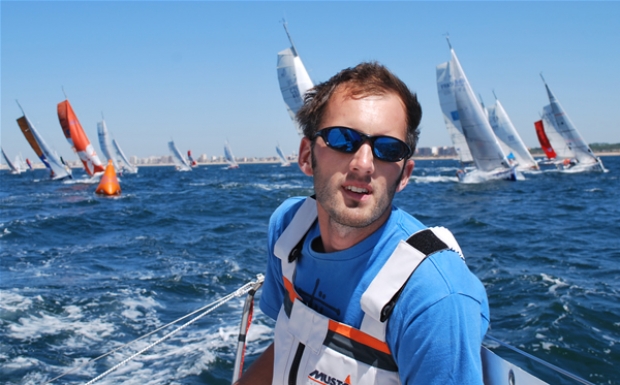
Mini Transat contender
Tuesday March 17th 2009, Author: James Boyd, Location: United Kingdom
Hurrah! 2009 is a Mini Transat year (one of our favourite events) when an enormous fleet of 21ft long pocket-sized Open 60s, divided in Proto (one-offs) and Series (production boats) classes, are sailed singlehanded across the Atlantic.
In fact with the changes made to the class, from now on every year is to be a Mini Transat year. Due to the biennial event perpetually being oversubscribed, with usually 120 boats fighting to get on the entry list for the 70-80 places available, finally after a decade of pondering the class has at last chosen to run the event annually. So in September this year, the Transat 6.50 Charente Maritime-Bahia (as the event is officially called) will run on its typical course from La Rochelle to Salvador de Bahia, Brazil via a stop in Madeira, while the event next year and onward for every ‘even numbered’ year will run from Douarnanez to Kourou, French Guyana, also via Madiera. The former is organised by the Grand Pavois, who’s main occupation is staging the boat show in La Rochelle, while the latter is organised by Winches Club, the same people who run the biennial doublehanded Mini Fastnet (starting on 13 June this year) and the shorter Trophee Agnes Peron warm-up before it.
After strong British representation over the last 12 years including the likes of Ellen MacArthur and Mark Turner, Alex Bennett, Sam Davies, Brian Thompson, Simon Curwen, Paul Peggs, Nick Bubb and Phil Sharp (forgive us for missing a few others) for some reason the number of British competitors in this phenomenal class has been dropping off recently. At present the strongest entry and a potential winner of the Transat is Ollie Bond. Impressively Bond podiumed in every race he did last year, including the arduous Les Sables-Azores-Les Sables. This will be his fourth year in the class.
Two years ago Bond failed to make the entry list for the Mini Transat. “I was a long way down the waiting list so I didn’t plan for it and then at the last minute they increased the entry, but I wasn’t really prepared for it,” he says.
At present this year only he and 2007 competitor Andrew Wood are on the entry list for the Mini Transat (Wood is still attempting to gain funding to take part this year) although others gunning hard include Keith Willis, racing the Pogo Two Rattle and Hum and Scotland’s Ross Turner on the 1999 generation Rogers Proto, Mini Skirt (the name inherited from previous owner Clemency Williams). Bond thinks Willis and Turner stand a good chance of getting an entry in the Mini Transat this year. “The entry list isn’t so oversubscribed - it is oversubscribed, but it is not by the same amount it normally is, so if you can qualify and get some extra miles early on this year, there is a chance that if people drop out then you’ll get in.”
Once again Bond is racing his Finot-Conq designed Pogo 2, the boat which Belgium Ecover-sponsored sailor Peter Laureyssens sailed to victory in the Series class in 2005. While in the past the coolest, most radical boats have been in the Proto class [remember it was here that canting keel first went ocean racing for example], due to the vast expense of building a new boat and employing a shore crew to prepare it, numbers in the Protos have been dwindling recently. A full-on Proto campaign can cost 150,000 Euros to build a boat and the same again to campaign it for two years.
Bond is naturally biased when he says the place to be in the Mini class is with a Pogo 2. Not only do Series boats typically outnumber Protos these days, but on the starting grid for most races around 70% of the Series boats are Pogo 2s or around 30 boats in most major events. And despite limitations on their rigs, the requirement to have GRP construction and even a compact galley, they have proved to be not that much slower than the Protos. In the Les Sables- Azores-Les Sables race last year, the first three boats were all Series boats, although Bond says that because conditions were so hard in this, the top Protos all experienced gear failure.
So how one design are they? “There is a set of Pogo 2 class rules: You have to keep the keel the same and the rudders and the mast is one design. Although you are not allowed carbon in the rule, you can add things like carbon foot chocks and solar panel mounts – little things. And the rules control the rig. The main thing that is open that is going to affect the performance is the sails. I have got some from Delta Voiles, that are very similar to the ones that Peter [Laureyssens] used. In fact I still use his genniker. They are last generation sails because it is a solent and a genoa - what people do now is have a small reefing genoa, which doesn’t seem to hurt performance too much in the breeze upwind and gives you an extra sail downwind. And so then people choose between having a Code 5 or having an extra medium spinnaker. If you go for the Code 5, the polars are nice and cover all the angles, but for the Transat it is more optimal to go for three spinnakers, because there is quite a lot of VMG running. The guy who won the last Transat didn’t have a Code 5 – he had three spinnakers.”
Obviously to get the edge within the Pogo 2 fleet, people are resorting to standard ‘getting ahead in one designs’ tactics such as reseating and refairing their keels, although Bond says this is reasonably academic compared to fully crewed boats. “Everyone seems to go the same speed if they have good sails and are good sailors. I think the most important things are sails and reliability.”
Bond reckons, or perhaps hopes, that the Pogo 2 will remain the boat of the moment in the Series class come this year’s Transat because there are several newer boats currently competing in the Proto class who are attempting to get to the required eight boats launched to enable them to be considered as a ‘Series’ by Classe Mini. According to Bond the most potent of these are the new Pierre Rolland-designed Dingo 2 and the new Nacira – examples of both were competing last year as Protos. “The Dingo 2 is a progression of the Dingo 1 – it is more powerful, it has a chine and has more rocker than a Pogo 2,” describes Bond. “I think it is possibly quicker than a Pogo 2 in light winds, upwind and down, but I think for the Transat the Pogo 2 is still faster, because it is quicker in the breeze downwind. Last year it did pretty well upwind to the Azores, but not so good on the way back down. In the Mini Fastnet he dropped back a bit on the run down. So I think it is not the optimal boat for the Transat, but for the coastal races around France it could be good. His old Dingo he used to do pretty well in the coastal races if you had a light wind race. I think it is a bit too optimised for light winds, but it is a bit more powerful than the last one.”
One of the boats from Nacira Design Group raced to third place in the Mini Transat two years ago. According to Bond Nacira have been working with former Transat winner Corentin Douguet, winner of the 2005 Mini Transat, who has been acting as a consultant on this boat and so for example the boat is well equipped for stacking, etc. “It has some nice design features on it, but I don’t think it will be worked up enough to win this Transat and I don’t know if they will build eight boats in time. But it might well be a contender for the Pogo 2. I can’t see a new design being such a big jump on from the Pogo 2 as the Pogo 2 was on from the Pogo 1. It is not like the Open 60s – there is a maximum beam and the Pogo 2 is already at maximum beam. You can put a chine in to make it more powerful [The Pogo doesn’t have a chine].”
As to the Protos, it seems that very few, if any, new boats are in build at present. However the top boats from 2007 such as the Yves le Blevec’s Transat winner Actual, the Finot-Conq designs of Isabelle Joschke and Peter Laureyssens and Mini designer/sailor Sam Manuard’s Sitting Bull have all gone to good homes and are likely to be the class acts within the Proto fleet this year.
As to his personal campaign Bond has recently been keeping his boat in Lorient, France rather than bringing it back to the UK. He has been training with the ubiquitous Tanguy Leglatin out of Pornichet in previous years, but he and others are attempting to set up a new training camp in Lorient. Already there are three Mini training camps in France – at Brest, Pornichet and La Rochelle.
“His reputation is growing - he is quite intense, but he has also got a really good technical knowledge, with rigs and settings, etc.” says Bond of his coach. “He spent a lot of time following Mini sailors and Figaro sailors and open 60 sailors and he is learning all the time as well. He has got better. I first did some training with him a couple of years ago and his knowledge is improving all the time. He pushes you hard.”
Among the training includes carrying out sailhandling blindfolded – literally – a test to improve ability at night, alongside doing a lot of speed testing and attempting to find repeatable settings.
Bond cannot recommend coaching enough: “The most cost effective improvement is to do some training. I don’t think I would have finished on the podium in every race last year without it.”
So could he foresee a time when he trains in the UK? “I’d like to and if I did, I know Tanguy would be keen to come over to the UK. But at the moment I don’t think you could train in the UK and aim for a top position in the Transat, because there aren’t enough people around to make it work, which is a shame. It would be great if there were five or ten boats in the Solent and you could set up a training group for the Minis, the Figaros and 60s. But it doesn’t seem to happen, so you have to go to France.” Organisation – that is what is needed!
In terms of funding his campaign, he bought his boat at the outset for 48,000 Euros, which in pound terms at the time converted to around £30,000 (although it is substantially more now). According to Bond, Pogo 2s typically still sell secondhand for this kind of price – around 45-55,000 Euros.
Once you have the boat then campaign costs can be as much as you like. Buy one sail and sali a couple of races in a season and it will only cost a couple of thousand reckons Bond, while at the other extreme if you are pulling the keel on the boat, refairing appendages, have a shore crew working for you and do lots of training and buy three suits of sails, then a season budget could be 60,000 Euros or more.
While Bond has his all-important entry in the Transat already confirmed, his racing calendar this year is more for training purposes. However at present this is up in the air. He will certainly do the Mini Pavois from La Rochelle down to northwest Spain as this is good training for the start of the Transat itself. The Pornichet Select before this may be too close. He is also entered in the other big Transat warm-up, the Transgascoigne, but again this is close to the start of the Transat itself and still fresh in the memory is how this event turned into a demolition derby in 2007.
Entry lists for all these events still have a waiting list but they are just not as long as they have been in previous years. Bond says this is a good thing: “It got to a ridiculous stage because you ent,ered more races than you actually wanted to do, because you couldn’t guarantee you’d get into them. So they have introduced more races and the Transat every year has improved it. I imagine that even if you get a diminished Mini fleet, you will still have a bigger fleet than you’d have in any other class. You’d still have 60 boats.”
Aside from his Mini sailing, Bond earns money as part of Dee Caffari’s Aviva shore crew and indeed the first woman to have sailed non-stop around the world in both directions has competed in the Mini class doublehanded with Bond. Provided he does well in this year’s Mini Transat – and given his track record and his approach he is in with a good chance – he would like to graduate up after this, possibly to a Class 40.
“I’d like to get a good result in it, but it is a really easy race to mess up. Favourites often end up not doing very well, because you can’t track your competitors and you have very little weather information. So it is quite a hard race to control. If I was really disappointed with the result I might try again, but I’d like to try a bigger boat after this.”
Watch this space...
Most Read
Most Commented
Comments
Businesses

Pro businesses
-
Italy
-
France
-
France
-
United Kingdom
Editor's choice
Member blogs
-
 Ned Collier Wakefield: MOD70 round BarbadosWell that was intense. 12 hard fought for seconds for the win. In idyllic conditions, Tony Lawsons MOD ...
 -
 Mini Transat leg 2 reportThe second leg of the Mini Transat started on 31st October, just over a month after ...
 -
Leg 1 reportI’ve been working towards the Mini Transat now for three years. In 2013 I was part ...
Business blogs
-
 The Island Sailing Club in Cowes, Isle of Wight, is delighted that Prince Michael of Kent ...
 -
Peta Stuart-Hunt chats with the 25 year-old British solo sailor Lizzy Foreman before she sets sail ...
-
The 2015 Student Yachting World Cup (SYWoC), an ISAF-recognised event hosted and run by students for ...
Editor's Choice
All time favourites...
-
 Three legs down into Ian Walker’s
 -
 Winning all but two races at
 -
 For the first time in its
Latest Comments
Add a comment - Members log in