
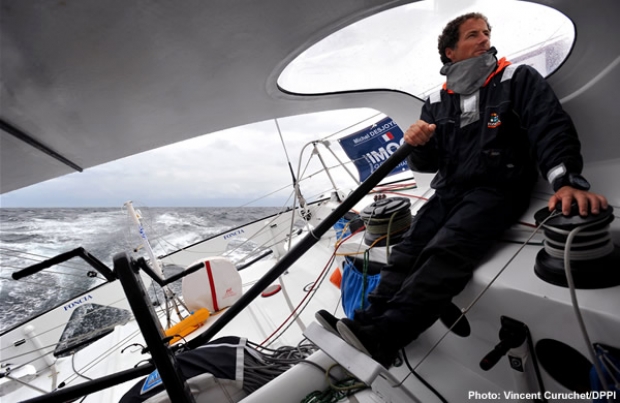
Not as easy as he makes it look....
Monday February 2nd 2009, Author: James Boyd, Location: United Kingdom
Video
In this long (32 minutes) video Jean-Paul Roux, Director General of Michel Dejsoyeaux's company Mer Agitee, gives us the full guided tour of Foncia.
Click here to see this video.
NB: This video are formatted to play in Windows Media Player and are LARGE in size - therefore only suitable for those with a suitably fast broadband connection. They should play out as they download. Mac users can now view .wmv files by downloading a suitable add on to Quicktime - for example we use Flip4Mac which works a treat. The only noticable difference is that while the clip will play out while downloading on a PC in Internet Explorer, on a Mac it must download first.
Becoming the first person to have ever won the Vendee Globe twice, so Michel Desjoyeaux has once again entered the history books, proving that he at least ranks alongside the very best French solo ocean racers in this notoriously difficult arm of our sport, be it Eric Tabarly, Philippe Poupon, Loick Peyron, Christophe Auguin, Francis Joyon, etc. Winning this Vendee Globe, despite starting 40 hours later than everyone, after he had to return to port to fix a leaking ballast tank, was a truly superhuman achievement.
For sure there were moments when Desjoyeaux was more fortunate with the weather as he caught up with his rivals, but most impressive was how once he was into the same weather system as they were, he still managed to forge ahead. To the other competitors it felt like Foncia was constantly sailing two knots faster than they were…
As Seb Josse, another front runner in the Vendee Globe and skipper of another Farr-designed Open 60, BT, says: “What is special about Mich? He is good! The boat is a little bit faster for sure. His boat is wider than BT by 15cm. And he did a really nice job on the weight side. He pushed really hard. He was partly lucky with the weather, but when he was in the same system as us, he was always going a little bit faster.
"After that he is just ‘MichDes’! It is not just on the Open 60 [that he does well]. He doesn’t sail in the Figaro, but he comes back and he wins that. When you know the level in the Figaro, you see he is the king!
Josse continues: “He pushed a little bit harder, that is for sure. When you look at the speed he does, he goes fast, but at an average speed. When you see Virbac push you know it is over the limit. When you see the average speed of MichDes, you know it is not over the limit. It is just a higher average speed.” In short Josse agrees that Desjoyeaux was able to get a higher percentage out of Foncia more safely than other people were, but we are talking small numbers to make a difference around the planet.
Josse reckons Foncia had a unique Solent/reacher that was the prefered Southern Ocean sail - this may be the high clewed Cuben fibre staysail Desjoyeaux has owned up to. “If you win 0.2 knots with a small reacher, you win 0.2 knots with a really light boat - that is already a half knot. You push a little bit harder and that is another half knot. It is no more complicated than that.”
1992 Vendee Globe winner Alain Gautier knows Desjoyeaux well. It was he who passed the Foncia sponsorship on to him (Gautier still sails a Foncia D35 cat on Lake Geneva) and Desjoyeaux has previously sailed with him on his trimaran, including an unfortunate capsize the two endured soon after the start of the 1999 Transat Jacques Vabre.
“He is a guy who is really talented, a hard worker, ingenious and I think he likes his job!” says Gautier. “It is basic, but he likes all part of his job - the technical, engineering, creating a lot of things and I think that is one of his best qualities to imagine. After he is good at a lot of things like weather and tactics, strategy.”
Gautier, who also was a safety consultant to the race committee for this Vendee Globe, reckons it is a combination of man and boat that won this race: “The boat I think is the lightest Farr design. It is not a big difference, but maybe 100kg and downwind it is in a good way being lighter. I think the boat is good, but it is not the difference. Mich has big confidence in himself and in his boat and that is the major thing. His brother built it, that is really important and he knows very well composite work."
Like Josse, Gautier reckons Desjoyeaux pushed harder than his rivals: “When you analyse it, you can see maybe on four nights in the South he took 25 miles off everybody. It wasn’t in big conditions, but it was during the night - during the day he was similar to the other guys who were pushing also. And sometimes in the start of the south you have to take some time to repair the boat. And he pushed harder then too.”
Also impressive is that a look around Foncia, now that she is snugly tied up in Les Sables d'Olonne's Port Olona where the pontoons are still swarming with public following Sunday's grand arrival - shows just how close Desjoyeaux came to not making it to the finish line of this Vendee Globe.
During the race our man said a lot, but in fact revealed very little about his predicament or what was going on on board. Shots or video he took from the boat were rarely looking at or along the boat or showing the sails for example. It was only when the majority of the fleet were out of the action and he was comfortably 500 miles ahead of second placed Roland Jourdain, with the finish line in sight, that some of the truth began to emerge. At this point we heard about how his race too had nearly came acropper on Christmas Day in the Pacific Ocean when the vital pin, acting as the axis point for his port rudder, broke leaving the rudder barely attached to the boat. Literally a miracle prevented it from snapping off completely and drifting away, that would have made Foncia and her skipper another statistic in this already costly race. It is a display of Desjoyeax’s technical ability plus a reasonable measure of luck, that he was able to effect a repair.
What wasn't made public until the boat reached the dock was the carnage on Foncia's foredeck. On the port side of the bow all the stanchions had been ripped off. Desjoyeaux says this was not due to sail mishandling, as might typically be the case (although he did destroy both his small spinnakers), but by the sheer deluge of water coming over the bow. That'll teach him to fit alloy stanchions...
Another potentially race destroying issue was the bowsprit. In the Indian Ocean some slack had developed in the bobstay holding the end of the bowsprit to the bottom of the bow, and this had allowed some lateral movement into the sprit causing it to crack either side where it joins the bow.
“In fact I made a mistake in the preparation of the boat,” Desjoyeaux admitted to thedailysail when we finally caught up with him yesterday. “Most of the problems I had were problems of preparation and not any of those problems were due to high speed or use of the boat or overloading the boat. With the bowsprit there is a carbon pin across the front of the bowsprit that keeps the rope [bobstay] at the front and this pin moved at the tie, so that it became soft and the bowsprit started to move. I had the genniker furled, but up, with a lot of wind and it started to break.”
Desjoyeaux managed to laminate over the cracks and was back in action, but had his repair not worked, he would have been unable to use his spinnakers or gennikers, all designed to be flown from the end of the bowsprit.
The bowsprit developed another problem coming back up the Atlantic - again not reported. On this occasion the pin holding the bobstay to the bowsprit came out completely and Desjoyeaux was forced to rebuild the bobstay - a loop of Kevlar with Spectra braid. Fortunately in the case of his rudder issue and the bowsprit/bobstay, he was saved by having some solid carbon fibre rod on board to effect a repair.

In addition to this Foncia had suffered a leak in her hydraulics at one of the gauges. A seal had broken, but again a miracle - Desjoyeaux had been able to fix it as quite by chance, among the spares for his watermaker there was another exact same seal.
During the race Desjoyeaux also managed to wipe out his two small spinnakers. All the sails on Foncia are masthead or virtually masthead (there is a halyard exit around 0.5m from the top of the mast). For this race he carried three kites, one big one at 420sqm and two smaller ones both 360sqm. Of the two smaller ones Desjoyeaux says: “One is quite an all-purpose one and the other has the advantage of a very straight luff, so it is very stable and in waves or shifty wind you don’t have to take care of it. It has less performance, but it is very simple to use. And the two spinnakers – I lost them into the water when I was hoisting them. You prepare it all on the deck and then you go on the halyard and by the time you get on the halyard everything has gone in the water.”
The first kite was destroyed in the Indian Ocean - he recovered it, but it was badly torn. Desjoyeaux says there was 18m of sewing to do - he got 5 or 6 metres into the repair before giving up on it as he realised he wouldn’t need it. Then the second kite blew up off Brazil coming home and he deemed it irrepairable.
But what about the man? It should be remembered that aside from his exploits in his previous Open 60 PRB, winning the Vendee Globe, Desjoyeaux is also a three-time Solitaire du Figaro winner, but most importantly prior to this Vendee Globe spent five years campaigning his ORMA 60 trimaran Geant in which he notched up singlehanded wins in the disastrous 2002 Route du Rhum (when he was the first of just three ORMA finishers) and the 2004 Transat from Plymouth to Boston.
Moving from an ORMA 60 trimaran back to an IMOCA Open 60 monohull is perhaps like going from a Ferrari to a Ford. We put it to him that this meant that the ultimate terror was less, but he wouldn’t be drawn by this, countering that the monohull is equally tough since it has more sails and thus there are more sail changes to be made. Desjoyeaux points out that all the most successful skippers in this Vendee Globe were ones who have spent time in the ORMA class, be it Jean le Cam, Vincent Riou, Roland Jourdain, Seb Josse or Armel le Cleac’h. “That helps us a lot in the south by accepting high speed for a long time without problem in high level conditions,” he says.
He doesn’t think time in the ORMA class changed his way of sailing or rhythm on board, how much or when he slept or ate or navigated. Interestingly he says that he slept a lot and was not once ‘in the red zone’.
The most significant difference this time in his opinion was Foncia being fitted with a sliding hatch covering the forward, working area of her cockpit. “Over the 80 days your most useful job is to trim sails and to manoeuvre the boat and you can do everything from the cockpit. If each time you have to trim you have to put on a dry suit to be sure not to be completely wet just a few seconds after getting out, then you don’t trim the boat and you go slower. I’m sure that is a good reason why I went so fast.”
Compared to 2000-1 he says: “I suffered a lot less this year. Maybe because I’m older, maybe because I have experience, so I was more at ease. The fact that I was setting out 40 hours later allowed me to to find my own pace, as I didn’t have to worry about the pace set by others. I kept sailing as I felt like sailing and that seems to have worked out well. I thought it would be impossible to catch up by Australia.” He also admits that the initial problem with his leaking water ballast tank and engine issue that resulted in his delayed start may have also put the required fire in his belly, that pushed him to play catch up.
Foncia
Following on from his mentor Eric Tabarly, Michel Desjoyeaux has always been a great innovator. It was he who first came up with the semi-circular main sheet track that doubled as a vang track, which he fitted to his Mini all the way back in 1991. But much more significantly Desjoyeaux’s Mini was the first offshore boat to employ a canting keel, subsequently adopted by Open 60s and then Volvo Open 70s, etc.
With his first Open 60 PRB (now Sam Davies' Roxy) in which he won the 2000-1 Vendee Globe, the boat was unique in having an entire nav station that could be canted up to weather, kick-up rudders recessed into the transom (rather than being transom hung) and a rotating wingmast - not with deck spreaders, but a set of spreaders hinged at the mast.
Inevitably with his new IMOCA Open 60 Foncia, Desjoyeaux was going to continue to innovate, although in this case in more refined ways. In this cycle, he was one of the first to sign with Farr Yacht Design, following on from their first generation Virbac-Paprec boat, which Jean-Pierre Dick campaigned in the last Vendee Globe (now Bernard Stamm's Cheminees Poujoulat). He initially set up to run the project as a two boat campaign with his 2000-1 Vendee Globe Project Manager and subsequent Vendee Globe winner, Vincent Riou and PRB. In fact the two campaigns shared the same moulds and had the same keels and masts initially, before they went their separate ways.
According to Pat Shaughnessy, President of Farr Yacht Design, Foncia and PRB were a little beamier and more powerful than their base boats BT and Delta Dore. “They started out with a similar heights of rig, but ended up with a bit more working sail area because of the wingmast and they’re slightly different with their reacher and headsail set-ups because of the deck spreaders.”
Both Foncia and PRB have a wingmast and deck spreader configuration compared to the fixed masts of BT and Delta Dore, which Shaughnessy reckons is heavier but has two advantages – it can rotate more than the non-deck spreader rotating wingmasts found on boats such as Paprec Virbac 2, Ecover and Aviva. Also the deck spreaders allow the headsail sheets to be passed through a ring that can be positioned, with judicious use of barber haulers, anywhere between the cabin top and the end of the deck spreader...
With Foncia, Desjoyeaux especially went for a minimum weight approach. She is certainly one of the lightest, if not the lightest of the Farr designs. According to Desjoyeaux she is 300kg under design weight, whereas for example Delta Dore and PRB were built at design weight ( PRB subsequently had a lighter keel fitted) . Foncia also had two keels and rudders built, the second keel being raked further aft. Desjoyeaux reckons the lightest of the new generation Open 60s is not Safran, as most thought to be the case, but her sistership, Kito de Pavant’s Groupe Bel.
In the cockpit there is only one coffee grinder (whereas Ecover 3 for example has two) and, significantly, only four winches - two primaries and two pit winches, and an awful lot of jammers...
Down below there is nothing. There is no chart table - all the instruments are stuck to the main bulkhead and while there are pipecots to port and starboard, the only furniture are two hollow beams (with the halyards, reefing lines, etc leading aft to the cockpit inside) which protrude upwards and outward as they head aft towards the cockpit bulkhead. Each of these beams has a socket on it, to mount a bucket seat and on both sides there is a computer screen and keyboard to run routing software, etc. In short the interior of Foncia is about as minimalist as you can get.

Unlike most of the other Open 60s, Foncia also only has one hydraulic ram operating her keel. While this may remove a safety component, ie having no back-up, this one ram went around the world without incident, and is obviously another weight saving over a twin-ram set-up.
There was some controversy surrounding Foncia prior to the start of the race when she failed to receive an IMOCA certificate. This involved a class rule that tries to prevent any sail handling taking place outside of the stanchions. On Foncia the stanchions at the transom run slightly less than a metre inboard, however she is fitted with genniker blocks right in the aft corners of her deck, which in theory would require Desjoyeaux to go through the stanchions in order to feed a sheet through them. To get around this he had rigged up a simple mouse system through the block, allowing him to pull the sheet through from within the stanchioned-off area of the cockpit [this is demonstrated in the video below]. Prior to the start, this was given the thumbs down by the class measurer, but, rather embarrassingly, given the all-clear by the race committee.
As always the devils is in the detail and Fonciahas some very interesting features. For example she, we think, is unique in having a mechanism that can alter, from the cockpit, the angle of her twin rudders relative to one another (ie how toed in or out they are). The linking arm joining the two rudders is in two parts and where they join there is a special screw mechanism that extends or retracts the linking arms: Very simple and operated by a tiny, innocent-looking yellow line at the back of the cockpit. .
Foncia is also a strong advert for Spinlock's range of ZS jammers. To back track a little – halyard locks are now familiar territory, as locking a halyard at the masthead rather than at the deck removes compression from the mast, and there are now a wide variety of slightly differing systems available from manufacturers such as Southern Spars, HallSpars, Facnor, etc to do this. However an alternative to these is the ZS jammer as it can be fitted with a spring release mechanism allowing it to be operated by a remote control line (as a halyard lock can). So Foncia uses these jammers as her halyard locks, but also on her outhaul (thereby removing compression from the boom) and even on her daggerboard downhauls, thereby removing compression due to these lines usually being under load. Clever.
Foncia obviously has the MichDes originated semi-circular track that is used for both the main and the vang. The top of the vang runs along a track on the underside of the boom so that it is always pulling vertically down on the track and not adding a forward compression load at the gooseneck (which in turn has a bearing on mast rotation).
In terms of sails, in addition to the three spinnakers, Foncia also carries one giant genniker, and a smaller genniker that is flatter, more of a Code 0 reaching sail. Then he carries a Solent, a jib, a storm jib and two staysails - one in Kevlar for the Atlantic “a nice flat sail” and another one in Cuben “a strong indestructible one with a high clew for the south.”
Compared to what he took on PRB in 2000-1, Desjoyeaux says that he took one more spinnaker. The wardrobe was made by Incidences and obviously the sail sizes are substantially larger with a rig that is 2m taller and different sail cloth - Incidences used D4. Otherwise Desjoyeaux says the philosophy of the sails for Foncia was the same.
The future
Sponsorship from estate agent/property manager Foncia, of Desjoyeaux continues for the rest of this year. His exact program is yet to be defined, but will certainly include the Transat Jacques Vabre at the end of the year. In between he will race once again in the Figaro class, attempting to become the first person to win the Solitaire four times!
Other than the Velux 5 Oceans and the Mini Transat he has won all the major events in solo offshore racing. “And,” he adds, “the crossing of the bay of Port la Foret!” Being the place from where he, Jean le Cam, Roland Jourdain and a bunch of other leading skippers in the Vendee Globe herald.
He hasn’t ruled out competing in the Vendee Globe again in the future.
As a multihull sailor we imagined that Desjoyeaux might be keen in following Thomas Coville and Francis Joyon into getting a large multihull for solo record breaking. But this doesn’t seem to interest him, although he perks up a bit when we point out that he could race one of these boats in the Route du Rhum.
Racing such a boat round the world he says is not for him. “It doesn’t mean other people can’t do it. I appreciate crossing the Altnatic in eight or 10 days because during those few days you are able to maintain your boat at a higher ratio of use, 100% performance. During such a long trip of 50 or 60 days you can’t maintain such a high level. So I don’t see the interest of such a competition.”
More photos of Foncia on the following pages....

Most Read
Most Commented
Comments
Businesses

Pro businesses
-
Netherlands
-
United Kingdom
-
-
Editor's choice
Member blogs
-
 Ned Collier Wakefield: MOD70 round BarbadosWell that was intense. 12 hard fought for seconds for the win. In idyllic conditions, Tony Lawsons MOD ...
 -
 Mini Transat leg 2 reportThe second leg of the Mini Transat started on 31st October, just over a month after ...
 -
Leg 1 reportI’ve been working towards the Mini Transat now for three years. In 2013 I was part ...
Business blogs
-
 The Island Sailing Club in Cowes, Isle of Wight, is delighted that Prince Michael of Kent ...
 -
Peta Stuart-Hunt chats with the 25 year-old British solo sailor Lizzy Foreman before she sets sail ...
-
The 2015 Student Yachting World Cup (SYWoC), an ISAF-recognised event hosted and run by students for ...
Editor's Choice
All time favourites...
-
 Three legs down into Ian Walker’s
 -
 Winning all but two races at
 -
 For the first time in its
Latest Comments
Add a comment - Members log in