
Calm before the storm
Sunday October 18th 2009, Author: Ollie Dewar, Location: United Kingdom
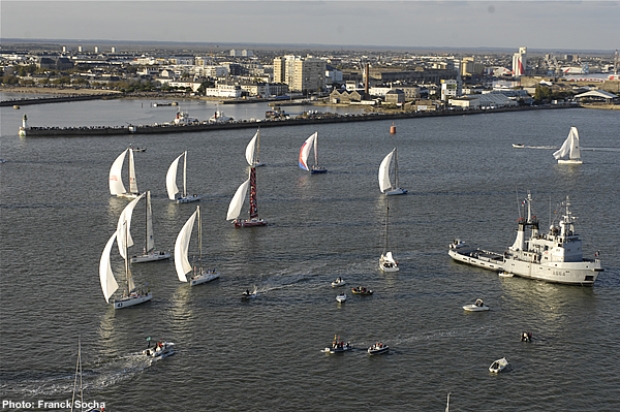
There were ideal conditions for the start of the first edition of the Class 40's Solidaire du Chocolat: Gentle downwind breeze, fine seas, sun and lots of spectators on the dockside in Saint-Nazaire. But for the 24 teams that set out at 1750 on the 5,000 mile long race across the Atlantic to Mexico, a radical change in conditions is awaited for Monday evening.
Party time in Saint Nazaire
At 1750, the start gun rang out off the East jetty in the port of Saint Nazaire, seeing the fleet on their way towards the Yucatan. An ebb tide and a 5-8 knot easterly were ideal to take the boats down the remainder of Loire and out into the open sea. Tanguy de Lamotte and Adrien Hardy on Initiatives-Novedia were the first out of the starting block, followed closely by Bruno Jourdren and Bernard Stamm on Cheminées Poujoulat. Both crews chose to leave under spinnaker on the starboard tack as they ran along the beach. The rest of the pack opted for port tack under spinnaker and were led out into the channel by Damien Seguin and Armel Tripon on Cargill-MTTM. The Chilean duo of Felipe Cubillos and Daniel Bravo Silva on Desafio Cabo de Hornos were also up with the leaders. Later on this evening, the pace should quicken as the southerly breeze picks up.
The fleet will have to make the most of these first 24 hours as the depression coming in from Newfoundland is not at all pleasant. A large low pressure system is hugging the coast of the British Isles and is set to sweep across the Bay of Biscay and the Atlantic. The front will pass through the fleet on Monday evening, bringing with it southwesterly headwinds of more than 35 knots, with gusts of up to 50 knots, accompanied by sleet, heavy rain, poor visibility and very rough seas. Things should be calming down a little by Tuesday morning when the wind is forecast to be 20 knots from the west, but this situation will not last for long. Between the Azores and Iceland, it will stagnate for a couple of days, blocking the weather set for the fleet, forcing them to put up with strong headwinds and a chaotic and heavy sea. Breaking waves are likely.
Make your mind up time
Beneath this depression, an area of high pressure is lying stable between the Azores and Madeira. The 24 Class’40s will have to go around this zone as there is no wind at all in the centre. There are two possible ways round it. The northern route to the Azores and the eastern option down to the Canary Islands. Even before the yachts left Saint Nazaire, some were clearly indicating that they were intending to "follow the barbaric route", by which they mean a straight line course across to the Azores while others were expressing the desire to "take a left turn as soon as we reach Cape Finisterre"
Many avoided giving a direct answer, suggesting that their mind was not made up - they had a clear vision of the strategies they could adopt, but remained open to the possibility that they might have to change their mind. In a yacht race, there is never one single definition of the optimal course to be steered. There is also the much more delicate question of how to go about marking your competitors.
"We’re in for a start in an easterly wind which will gradually be veering to make for upwind sailing," commented Bernard Stamm. "We’re going to have to make the most of the first 24 hours to reel in the miles. The usual scenario thereafter down the bay of Biscay on a direct course to pick up the trade winds is likely to be compromised. The front expected to kick in will gain in importance with the high is positioned further down. If we can’t get down below the first low pressure system, that should reshuffle the odds somewhat. A bit like starting all over again!"
Knowing their boat is essential and her particular qualities will help determine various choices - the Pogo 40s, Ker 40s and Jumbos are not that bad in head seas upwind. More recent designs such as the Rogers, Verdier and Owen Clarke boats have the power necessary to push through in rotten conditions. Another factor to bear in mind, is the capacity of man and machine to withstand extremely tough conditions without breaking gear and wearing them out.
So the front on Monday to Tuesday is going to be very tough indeed. Those who opt for the Azores option are going to end up in a hefty northwest flow of more than 30 knots on Wednesday. For them there will be no choice but to continue to slam through the waves tiring on their boat’s structure and rig. Those who opt for the Madeira route will be sailing free in a westerly flow of around 20 knots, a faster option, making for more pleasant sailing, with the downside of their having to sail a much longer course.
By next weekend we will know which option has paid. Part of the pack will be beating themselves out in strong winds and hectic seas in the middle of the Azores, while the other will be gliding on the trade winds between Madeira and the Canaries. And that is just the start of business. What will happen after this? Will there be any wind if the Azores high returns north? Will the trades drop off after the Canary Isles ? It is anybody’s guess.

Most Read
Most Commented
Comments
Businesses

Pro businesses
-
United Kingdom
-
France
-
France
-
Editor's choice
Member blogs
-
 Ned Collier Wakefield: MOD70 round BarbadosWell that was intense. 12 hard fought for seconds for the win. In idyllic conditions, Tony Lawsons MOD ...
 -
 Mini Transat leg 2 reportThe second leg of the Mini Transat started on 31st October, just over a month after ...
 -
Leg 1 reportI’ve been working towards the Mini Transat now for three years. In 2013 I was part ...
Business blogs
-
 The Island Sailing Club in Cowes, Isle of Wight, is delighted that Prince Michael of Kent ...
 -
Peta Stuart-Hunt chats with the 25 year-old British solo sailor Lizzy Foreman before she sets sail ...
-
The 2015 Student Yachting World Cup (SYWoC), an ISAF-recognised event hosted and run by students for ...
Editor's Choice
All time favourites...
-
 Three legs down into Ian Walker’s
 -
 Winning all but two races at
 -
 For the first time in its
Latest Comments
Add a comment - Members log in