
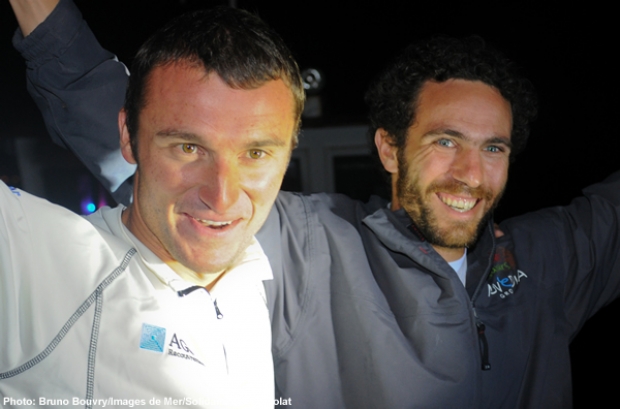
Tanguy de la Motte (right) with co-skipper Adrien Hardy
Winner's tale
Monday November 16th 2009, Author: James Boyd, Location: United Kingdom
Tanguy de LaMotte and Adrien Hardy, aboard their Rogers-designed
Initiatives Novedia, secured first place in the Class 40’s inaugural doublehanded transatlantic race – the Solidaire du Chocolat – between St Nazaire on the mouth of the Loire river and Progreso on the north side of Mexico’s Yucatan Peninsula. Yesterday we caught up with Tanguy...
thedailysail: So we hope you haven’t drawn a sober breath since arriving?
Tanguy de LaMotte: We had a few drinks yesterday with Giovanni [Soldini] and Bernard [Stamm] and Bruno [Jourdren] and Pietro [d’Ali]. But they didn’t arrive too late so I was in bed by 1am - I hadn’t got much sleep when I arrived because my sponsors were here and one had to elave six hours after I finished. So I spent some time with them and I didn’t go to bed at all. But last night was good and the guys they finished 18 minutes apart from each other. They were fighting all the way to the end and they looked pretty tired and they had lots of stories to tell.”
tds: You led for pretty much the entire second half of the race...
TdlM: In fact we led virtually the whole race because we were in the south all the time. Sometimes it doesn’t say that on the position reports because that is done to the finish line. Giovanni [Soldini] took the lead for a week and for the first five days there was a rolling leadership. So at least for the last 10-12 days I think we were in the lead. Also it was the time when to be in the front, because the conditions were always going to be better for you.

tds: Your winning move seemed to be going south half way across the Atlantic?
TdlM: There were two critical moments, one before the Azores: We were a little further south than the group of three boats, - Giovanni [Telecom Italia], Bruno [Cheminees Poujoulat] and Thierry Bouchard [Mistral Loisirs]. They were heading for a low pressure and we thought they could never be able to go around the top of it. And they couldn’t. We went south immediately. At that time three low pressures had gone past us. I think they were pretty tired and they didn’t make a very conscious decision – they just carried on. We were obviously really tired as well, but we were I think younger and perhaps we had better physical strength and we kept our heads clear. So we decided not to go for this low pressure, because the timing had to be perfect to succeed in this winning plan and it turned out that it didn’t work out for them. Also the guys who went up there had a lot of strong winds again and Mistral Loisirs had to retire from the race because of damage and Bruno and Bernard had some damage as well. So just for that reason it was a good choice not to go in strong winds again.
Then the second time was when Giovanni actually was heading west towards the last of the low pressures in the Atlantic. With the timing he could have made it but if he had been an hour late he would have got hammered. So it was risky to go for this kind of option and at the end they pulled the helm and they went south. Pietro said ‘we should go and stay with the other guys. We are not going to make this one a winner, but at least we can fight that with Bernard and Damien Seguin on Cargill’. I don’t think Giovanni was happy with that decision, but I think also the timing had to be prefect for him to pull ahead doing that move. Later he broke his forestay and luckily he didn’t lose it at that time otherwise he would have lost his rig. He said that they only put the staysail halyard on the mast the night before the forestay broke and that is why he didn’t lose the rig. And also they didn’t even tied it up properly – they just put a knot on it and left it there. So when the forestay broke the mast was 20 degrees back - really close to a massive disaster. He was laughing about it yesterday – that was depression number six but it might have been the end of it had he gone for it.
tds: Did you suffer any damage?
TdlM: We always said that to win the race we needed to finish so we needed to look after the boat. We had lots of damage on the boat – luckily things we could fix: we broke the pushpit with the genniker, we broke some halyards, we didn’t have any wind instruments from day three and we had a little structural problem in the boat because of the slamming. After a while you have to realise the guys on board are human and after 10 days of upwind slamming and everything you are not the same as you are at the start. You are not making the same decisions and then you make mistakes.
tds: The weather was atrocious – where you expecting it to be half that bad?
TdlM: We probably were expected it to be half as bad as it was! It was twice as bad as we expected. Also for Adrien it was doubly tough because we had never raced the boat together, we only did the qualifier and that was in pretty light winds and he didn’t gauge the strength you need to manoeuvre the boat and how physical it is. So after a while we were stacking the gear together inside and we looked at each other and said “we can’t carry on like this forever, so we need to be careful of the choices we make to make sure we can carry on and race the boat at 100%”. So we tried to stick to simple strategies, go close to the rhumb line and make the fewest mistakes as possible. Also we had to sail with no instruments - we just had the GPS on the computer, we had no wind, no nothing, so it was a case of going back to basics like the Mini Transat: Just go straight and go fast and hopefully you are doing well.
Tds: How did it work out with Adrien – did you share everything? When did you sleep?
TdlM: Adrien is a big sleeper! I thought I was a big sleeper, but he is bigger than me! It is fair enough. We had a really difficult first two weeks and if you want to think straight you need to sleep and you need to be on top of your game. I think that was a strong point from him, to make sure we slept the maximum amount of time. Before the start we decided that he would be in charge of the weather and the routing and getting the information because I knew the boat better than him, so I was more in charge of choosing the sails and hitting the target speeds, etc. So he did most of the weather analysis, but we took all the decisions together and we were on exactly the same wavelength. We agreeing on everything, every time we wanted to make a decision, he would look at the weather first and then I would look at it and then we would discuss it and then we found we had the same idea about what to do it. So that was really good.
We have known each other for a while, but we never raced together, so we had this little unknown about how we would work together, but because we went into the strong weather straight away we quickly realised we had to team up. I say that because sometimes in those circumstances you go into such a safety/survival mode - you don’t think about the other guy, if he is drinking or eating enough or sleeping enough. On the second night we said we really need to take care of each other and we must work together instead of alongside each other. So we would stack the gear together. We needed to have four arms instead of two plus two, which is not exactly the same. We went into strong weather straight away and we knew it was the only way to get through it.

tds: So were there any big wipe-outs and scary bits?
TdlM: We had some pretty severe squalls. It is hard to say how much wind we got. Before we lost the wind instruments we had 48 knots. I think we saw more than that. For sure upwind you don’t have any big wipe-outs, but when you have big clouds coming and you haven’t taken a reef or you have to take the solent down on the foredeck and it is blowing 45 knots, it is not a wipe-out but it is a pretty tough manoeuvre. Apart from that on the downwind we didn’t broach or have any problems. We had one crash tack because the pilot stopped. That was two nights before the finish- it wasn’t scary, but it was a little reminder that the race wasn’t over.
tds: It seemed like a very very long race?
TdlM: It is a very long race in distance. Basically it is long because once you reach St Barts, you still have 10 days to go. It was strange for us - it sounds a bit arrogant – but we were too far ahead to be under any big pressure. It is like you go to a [rich] friend’s house and you find the entrance of the residence, but then you still have to walk five minutes to find the front door. It was really nice part of the race because we passed St Barts and the Virgin Islands, Jamaica and Cuba, the Cayman Islands – it is amazing to go past these places. But for us it was a bit long - 1,600 more miles.
tds: What is it like in Mexico?
TdlM: It is really amazing. There is music going on behind us. It is really a small place, but the local population is really friendly. They can mix with us. The village is completely open. We have a little press centre and a little display with some explanation of the boats, of all the sponsors and the charities we raced for. The people walk around. It is like a European race village. It is not like when you finish in Brazil and you are stuck in the sailing club and you can’t talk to anyone from Brazil. Here there is a big jetty where we moor the boats when they finish and at any time of day there are 100 people looking at the boats. When we walked down the jetty yesterday with our beards, people asked if they could take photos of us with their kids and they asked us about how long it took, how much wind, etc. It is really nice to have that exchange with the population.
Tds: And the plan is to hold this race again in two years time?
TdlM: That is the plan and I’d like to do it again for sure. They want to do a second race to finish here in 2011. And they have made such a big effort here. It is a really big national effort. You can see that they are proud to welcome us and proud of what they have done to make their place a little better because they have some government help to paint the buildings and create this little area here. And now they can have kids coming here on holiday. So it is not just a yacht race, there is a big project behind it and the Yucatan government has changed big things here. It is good that we can think because of races they have changed things here. And relations between Nantes-St Naziare and Yucatan is very strong. I’m sure in 2011 we’ll see more boats. Because of the toughness of the race, I think this race will be become like the Fastnet of transatlantics. It is more difficult than the Route du Rhum and tougher than the Transat Jacques Vabre when it finished in Brazil.
tds: The TJV competitors have had a similar experience to you though this time?
TdlM: They had only one [depression] but it was a much bigger one.
tds: What’s the plan now?
TdlM: I’m going to stay until the prizegiving on the 21st. Mon-Wed I am going to rent a car with Adrien and a couple of other guys and we will go and see the Mayan ruins. Then we will probably go to the Caribbean coast - there is a little island there which I got told to visit. I don’t know what I am going to find them. Then we will pack the boat up and change to the delivery sails and deliver the boat to the Caribbean. I am going to do the RORC 600 at the end of February. I’m not going to do Antigua Sailing Week this year, but someone is going to deliver the boat to the Azores and then I am going to do a singlehanded qualifier and training for the Route du Rhum.
Most Read
Most Commented
Comments
Businesses

Pro businesses
-
Netherlands
-
France
-
Italy
-
United Kingdom
Editor's choice
Member blogs
-
 Ned Collier Wakefield: MOD70 round BarbadosWell that was intense. 12 hard fought for seconds for the win. In idyllic conditions, Tony Lawsons MOD ...
 -
 Mini Transat leg 2 reportThe second leg of the Mini Transat started on 31st October, just over a month after ...
 -
Leg 1 reportI’ve been working towards the Mini Transat now for three years. In 2013 I was part ...
Business blogs
-
 The Island Sailing Club in Cowes, Isle of Wight, is delighted that Prince Michael of Kent ...
 -
Peta Stuart-Hunt chats with the 25 year-old British solo sailor Lizzy Foreman before she sets sail ...
-
The 2015 Student Yachting World Cup (SYWoC), an ISAF-recognised event hosted and run by students for ...
Editor's Choice
All time favourites...
-
 Three legs down into Ian Walker’s
 -
 Winning all but two races at
 -
 For the first time in its
Latest Comments
Add a comment - Members log in