
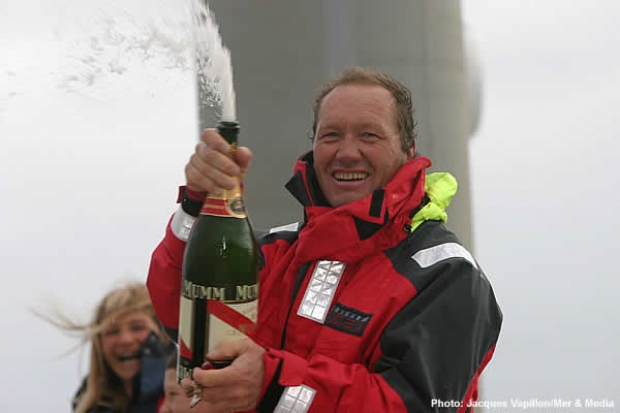
Singlehanded speedster
Wednesday February 4th 2004, Author: James Boyd, Location: France
72 days 22 hours 54 minutes and 22 seconds. Probably like the first time someone broke the 4 minute mile or ran 100m in less than 10 seconds, Francis Joyon's time sailing a 90ft trimaran singlehanded non-stop round the world seems impossible.
Prior to his departure on the morning of Saturday 22 November 2003 it seemed probable that Joyon would beat Michel Desjoyeaux's singlehanded record set in the last Vendee Globe. That assumed that he made it round - the oceans are littered with flotsam and anything from a stray log to a semi-submerged container would be quite capable of ripping the bottom off a fragile trimaran float. Then of course there is the potential to encounter Mother Nature's very own flotsam - icebergs and growlers. Giant multihulls are often not the most reliable boats - what if something broke?
There was also the issue of how could one man, admittedly a burly Frenchman, handle such a giant boat with a such a massive sail plan to any degree of efficiency.
If Joyon made it he would be only the fourth person to succeed in sailing around the world singlehanded on a trimaran. The pioneer of this elite and short list was the legendary Alain Colas on board the 70ft trimaran Manureva in 1973 who set a time of 169 days. It was not until 1987 that Philippe Monnet dropped the record to 129 days on board the 78ft trimaran Kriter and was followed in 1989 by Olivier de Kersuason aboard the 75ft trimaran Un Autre Regard lowering the time to 125 days. None of these were 90 footers.
When the trimaran IDEC set sail from her homeport of La Trinite-sur-Mer everyone had their fingers cross Joyon would make it round in such a big multihull. Few dared imagine a singlehanded circumnavigation in less than 80 days to be possible. Anything less than 75 days was inconceivable.
To put Joyon's record into context it was less than 10 years ago that Bruno Peyron and his crew on Commodore Explorer became the first humans ever to sail around the world non-stop in less than 80 days - they managed a time of 79 days 6 hours 16 minutes. Joyon's time is faster even than the Jules Verne Trophy record set a year after Peyron by Peter Blake, Robin Knox-Johnston and the crew of ENZA New Zealand, who managed 74 days 22 hours 17 minutes.
But greater comparison deserves to be made with Olivier de Kersauson's Jules Verne Trophy attempt in 1997 aboard Sport Elec when he reduced Blake and Knox-Johnston's time to 71 days 8 hours 22 minutes and 8 seconds. For Un Autre Regard, Sport Elec and Joyon's IDEC are one and the same boat - albeit substantially modified.
The boat
A design by Marc van Peteghem and Vincent Lauriot Prevost, Joyon's trimaran was built by CDK Composites for Olivier de Kersauson to campaign in the 1986 Route du Rhum. Fresh out of the box she was 75ft long (at the time the maximum length for a class one multihull), had a memorable metallic pink paintjob and was named Poulain, after her sponsor, a maker of upmarket chocolates.
In the late 1980s de Kersauson campaigned the boat on the French circuit in events such as the Open UAP Round Europe Race and the La Baule-Dakar race, before tackling the singlehanded round the world record. His solo round the world attempt came shortly before the first Vendee Globe and it has since been held by winners of that race - Titouan Lamazou in the first in 1989-90 managed 109 days and ultimately the record was parred down over the course of four races to Michel Desjoyeaux's time of 93 days 3 hours 57 minutes and 32 second - the record at the time of Joyon's departure.
During the 1990s the boat was solely used by de Kersauson to make attempts on the fully crewed non-stop around the world record. In 1993 the boat, named Charal and much modified, had it's first go alongside ENZA New Zealand and Bruno Peyron's Commodore Explorer. For de Kersauson his voyage was cut short when approaching South Africa Charal hit a growler forcing him to retire. Commodore Explorer was the only finisher and the first to set the Jules Verne Trophy.
For the following season the boat was modified further - extended to her present length of 27m (89ft) with new floats and a slightly taller mast. For the 1994 attempt the boat was renamed Lyonnaise des Eaux Dumez and this time made it round - but in a slower time than ENZA. After other attempts on the record, including several aborted ones, it was finally in 1997 that de Kersauson succeeded in winning the Jules Verne Trophy.
With de Kersauson now strutting his stuff in a new maxi-trimaran - Geronimo - Joyon was able to charter his old boat. One of the most remarkable aspects of Joyon's voyage was that IDEC was little changed from when she was Sport Elec. The only ostensible difference is her paint job, which Joyon is rumoured to have applied himself with a roller, and she now has roller furling headsails. Her mainsail for example is the same one de Kersauson used on his Jules Verne Trophy win in 1997.
So Joyon's voyage was all the more amazing because it was tackled on a shoestring.
The man
Central to Joyon's character is that he is a product of France's most famous sailing school - les Glenans - alongside the likes of Jean-Luc van den Heede. The Glenans has influenced many many French sailors promoting seamanship first and foremost, the KISS principle (keep it simple, stupid) and a heightened affinity and understanding of their environment - the sea. Glenans sailors can be recognised as the ones who know how to scull a dinghy and who like to sail on to their mooring (marina berths are also not in the Glenans philosophy).
Bitten by the sailing bug, even when he returned home to Epernon, southwest of Paris, Joyon was motivated enough to build his own boat - a 9m long cold moulded monohull in which he took his family cruising to Africa and South America.
His appetite for racing came about in the 1980s when he witnessed a multihull grand prix in Martinique. Suitably enthused he bought the hulls of the old Elf Aquitaine catamaran, rerigged it and campaigned her as JB Express in the 1988 Route of Discovery race, finishing a respectible third.
He subsequently befriended the late 60ft trimaran skipper Paul Vatine with whom he raced in the 1989 Round Europe Race. This trip on board the 60ft Irens trimaran Region Haute Normandie inspired Joyon to have a crack at singlehanded offshore racing himself. Without a sponsor he bought the yellow Adrian Thompson-designed 60ft trimaran Paragon and raced her to 10th place in the 1990 Route du Rhum. He followed this up with a series of third place finishes in the 1992 OSTAR, the Route du Cafe (predecessor to the Transat Jacques Vabre) and the Round Europe Race, sailing one of the oldest boats in the fleet.
Having proved his worth Joyon was sponsored by Banque Populaire and was able to build a new boat - another Nigel Irens design and a sistership, albeit a cheaper lower-tech version, to probably the most successful 60ft trimaran ever - Loick Peyron's Fujicolor. In this Joyon continues to finish on the podium or in the top five, although never actually winning. But as time wore on, he also was becoming increasingly unhappy with the professional sportsman lifestyle that sponsorship from the French bank was placing him in and in 1999 there was a parting of the ways. Banque Populaire chose Lalou Roucayrol as their new skipper and had a new Marc Lombard-designed trimaran built for him.
The defining moment for Joyon came during the 2000 Europe 1 New Man STAR. As all the glamorous ORMA trimarans fleet lay shimmering in Plymouth's Queen Anne's Battery Marina, a small army of shore crew on each, Joyon's slightly grubby white trimaran painted in the colours of his new but modest sponsor Eure et Loir lay on a mooring off Mountbatten with Joyon alone working on board her.
It was thus with utter satisfaction that Joyon went on to demolish the opposition in this race achieving his first major win and his place in the history books. Meanwhile Banque Populaire suffered a capsize and was abandoned mid-Atlantic on her first race. Joyon and Eure et Loir have also competed in the UK, setting a new course record for the Round the Island Race and were first home in the 2001 Fastnet Race.
Racing with Joyon on both these occasions was British triple Olympic medallist Rodney Pattisson. Since Joyon bought Paragon off him the two have become close friends and Pattisson holds the utmost respect for the Joyon. To prove this Pattisson was in Brest for Joyon's arrival today and as the Frenchman stepped ashore Pattisson presented him with the gold medal he had won in the Flying Dutchman at the Munich Olympics.
"I felt that what he’d done was so magnificent," Pattisson told thedailysail afterwards. "In my sport I’ve always felt the Olympic Gold medal was the pinnacle of success, but I don’t think it is compared with something like this. So when he came ashore I presented him with my Kiel gold medal and said ‘look Francis, you deserve this for what you’ve done and I want you to keep it’. He wore it at the press conference. I think he was pleased with the gesture and I felt it was the least I could do. I was honoured I could give it to him.
"It couldn’t have happened to a more deserving man. You’ll never find a more modest and kinder guy and a lovely family man with a delightful wife and kids who he adores. He smashed the record and it will be very very difficult for anyone to beat it. He deserves to hold it for many years to come."
On board a boat Pattisson describes Joyon as being a superb seaman "and very experienced and that’s important. He’s an absolute gorilla - he is so strong, yet he’s not that heavy - only 14 or 15 stone."
Perhaps a most important characteristic for sailing big powerful multihulls singlehanded offshore, Pattisson says he is 'panic-less'. "A crisis isn’t a crisis to Francis. If anyone can sort it - he can. He is a superb diver. I will always remember when he turned Banque Populaire over when he was winning the 1996 OSTAR off Newfoundland. He took a lift off the boat and came back with a fishing boat and he salvaged her himself. He dived, got the rig off, filled up a float and righted her. No one else would have done that. Anyone else would have wrecked her trying to do anything.
"And when he turned over Eure et Loir in the Route du Rhum [in 2002], he was three days on that boat waiting to get a tow in and refusing to pay certain prices. Three days upside down in those horrible conditions. Other people would have just got off the boat and left it to the sponsor to sort out."
In that race once again Joyon was among the frontrunners, despite having one of the oldest boats, without the latest curved foils, with no canting wingmast, a smaller sail area, etc. "He was winning the race because he was the underdog and had to fight harder than anyone else," says Pattisson.
Joyon is 47 years old and unlike many of the younger more technically-inclined trimaran sailors, he is more a belt and braces man. "I will always remember, when he brought Eure et Loire over and I joined him on the Friday afternoon and went on board and he was fiddling around down below and I said ‘we ought to put the waypoints in for round the island tomorrow’ and he said ‘oh, I suppose we ought to’. And he started trying to put them in with the greatest of difficulty," recounts Pattisson. "And I said 'what is the total mileage?' and he said ‘I don’t know how to do that...'" So I asked him - he’d just won the OSTAR - ‘how did you win the OSTAR, how did you get to Newport?’ And he said ‘it was dead easy - I only needed to put in two waypoints...’"
Tomorrow we will look at the nuts and bolts of Joyon's voyage, we find out from the man how he did it and look at the implications for Ellen MacArthur.
Most Read
Most Commented
Comments
Businesses

Pro businesses
-
-
United Kingdom
-
-
United Kingdom
Editor's choice
Member blogs
-
 Ned Collier Wakefield: MOD70 round BarbadosWell that was intense. 12 hard fought for seconds for the win. In idyllic conditions, Tony Lawsons MOD ...
 -
 Mini Transat leg 2 reportThe second leg of the Mini Transat started on 31st October, just over a month after ...
 -
Leg 1 reportI’ve been working towards the Mini Transat now for three years. In 2013 I was part ...
Business blogs
-
 The Island Sailing Club in Cowes, Isle of Wight, is delighted that Prince Michael of Kent ...
 -
Peta Stuart-Hunt chats with the 25 year-old British solo sailor Lizzy Foreman before she sets sail ...
-
The 2015 Student Yachting World Cup (SYWoC), an ISAF-recognised event hosted and run by students for ...
Editor's Choice
All time favourites...
-
 Three legs down into Ian Walker’s
 -
 Winning all but two races at
 -
 For the first time in its
Latest Comments
Add a comment - Members log in